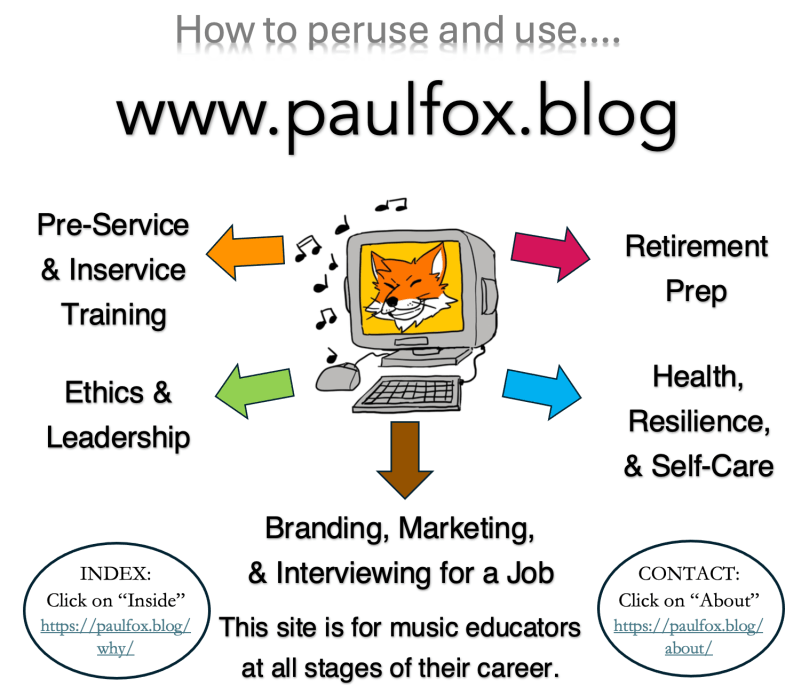
How to Peruse www.PaulFox.blog

A Guide for Music Educators at All Stages of their Career

It’s time for a celebration! Since its creation in July 2015, this represents the 217th blog-post at this WordPress website!

My apologies to first-time visitors who may find themselves a bit overwhelmed at the incredible volume of submissions posted to this library.

The purpose of this project after my retirement from public school music in June 2013 was to archive my writings and organize them in one convenient location. As Simon Sinek would emphasize at one of his keynote speeches, the essential “WHY” and rationale for http://www.paulfox.blog is the value I hope my articles could serve to prospective music teachers “in the trenches.” Many of us retirees just want to feel needed and seek opportunities to offer the benefits of our “boots on the ground” to future professionals. We seek to “matter” throughout our retirement and stay active in our post-employment years. The mission and goal of this website is to “make a difference” and share a legacy of more than five decades in the profession, providing the supports of hard-earned lessons learned, anecdotes shared, short cuts developed, perspectives observed, and additional research and practical tips found applicable to the field of music education and creative self-expression.

I write for myself, not to earn credit or receive validation from any external source. But, of course, I hope somewhere out these someone eventually finds these “creations,” reads them, and actually puts some the material to work for them in their job.

Unraveling the Maze of Menus

Articles posted at most blog-sites are published in chronological order… formatted to what computer programmers would term as “sequential.” This structure is similar to a tutorial, directing the reader to consume the contents from beginning to end (Introduction, Chapter 1, Chapter 2, etc.), reading “in sequence” earlier posts for full comprehension. This is the same basic format of paulfox.blog.

However, for academic or research study, my articles may be viewed in any order, similar to the “random access” format of a reference manual. (Go to the specific relevant section you are seeking information.) Everything is digitally stored under these categories (also accessible from links printed inside the right panel):

A reader might prefer to skim through an outline of potential reading material by clicking on the menu bar at the top of the page:

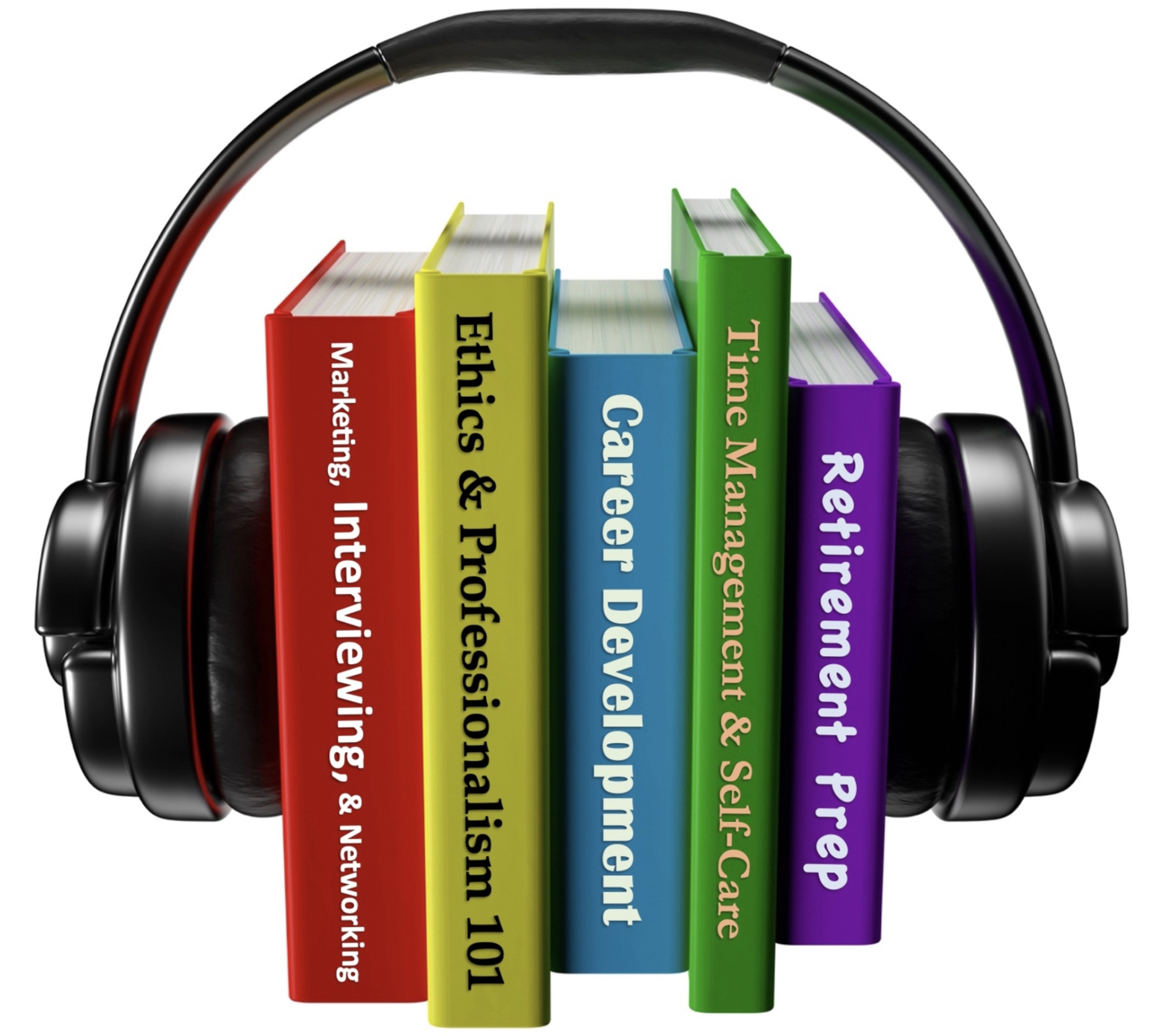
  • About: My contact information, curriculum vitae, recent workshop or conference presentations, professional brochure, and printer-friendly catalogs of articles and presentations
  • Inside: A frequently updated index (by subject) of all blog-posts at this site
  • Training/Jobs: Listings of articles and online resources (in chronological order) and past workshop/conference slide summaries and handouts (in reverse chronological order – most recent first) on the topics of pre- and inservice training in music education, ethics, building professionalism, and techniques for marketing, interviewing, and landing a job.
  • Care: Presentations, recommended books, and website resources on health, wellness, and burnout/stress remediation, and developing a self-care plan
  • Retirees: Alphabetical reference to articles and other resources on retirement preparation, mostly on post-employment self-reinvention and truly “living the dream” in our senior years
  • Creativity: My three-part series on creativity in education plus a short list of creativity geniuses/educational gurus and their books
  • Firesides: Tips for the enrichment of musicians of all ages, including practice hacks/hints and a collection of PDFs presented in the South Hills Junior Orchestra Online Academy

Explore the Links, But Beware!

Thousands of hours has been spent writing these “epistles,” and whenever possible, I try to reference background information, attributions, follow-ups or research sources. The Internet is an amazing tool, but it should not come as a surprise to anyone that some of the links in my older blogs may have broken connections or return errors. This is best explained by Google AI:

“Links on the internet become inactive, known as link rot, when a website owner deletes a page, changes the URL structure, or shuts down a domain entirely. Over time, servers go offline, companies close, and paid web hosting plans expire, which breaks the digital path to the original content.” [1, 2, 3, 4, 5]

Copyrighted material may be taken down as the authors move on to other pursuits or decide to restrict it to print-publish their work. A case in point, one of my favorite “experts” on creativity and author of Instructional Strategies for Thinking, Collaboration, and Motivation, Dr. Curtis Bonk from the Indiana University of Bloomington removed his amazing graduate course handouts and PowerPoints referred to in several of my creativity blogs. I still lament the fact that his “Best of Bonk” website is gone!

Whenever possible, I “nail down” a snapshot of the data, context, and clarifications with supportive PDF files and copies of my slide decks. At the time of their creation, the links were active. However, it has become necessary to update many of my more recent versions of commonly-repeated presentations, e.g., Retirement 101, Interview Clinic, Take the E-Train (Ethics), etc. The older the conception of the work, the more likely that something in it has become inactive.

If you find something is “broken,” please give me a holler. Send me an email describing the problem to paulkfox.usc@gmail.com.

Comments Welcomed!

Directly under the title of each blog are printed the date of its creation, my signature, and a small symbol with the text “Leave a Comment.” CLICK ON THIS! I encourage feedback! Share your perspective. Add your own experiences, thoughts, or sources of information. I fervently hope I am not needlessly shouting in a wind storm trying to reach an audience who cannot hear me but could perhaps be best served by this open, two-way communications and divergent opinions.

Some of the posts receive significant initial and repeat traffic. I’ve noticed especially for those blogs on marketing professionalism and interview tips/questions, things pick-up in early spring, perhaps when graduating music education majors may be completing preparations for employment screenings. (Believe-it-or-not, one of the highest rated blogs last month was Dress for Success at Teacher Interviews!) So, if you have anything to add to help pre-service colleagues (soon-to-become teachers), click on the comment symbol or send me an email and share your advice! I would be happy to post your insights in a future blog!

Highlights

These might be my “top ten” blogs (in alphabetical order) to get a good idea what is available for further research.

  1. 52 Creative Tips to Supercharge the School Musical
  2. Creativity in Education
  3. Ethics Follow-up with links to all four parts of a general discussion on school ethics)
  4. The Five Cs of Self-Care – Teachers Take Charge of Your Wellness
  5. Get a Job Toolbox
  6. The Importance of Music Education
  7. Job Interview Rubrics
  8. Leaders Flush
  9. RECAP – Retirement Resources – A Treasure Chest of Tips for “Living the Dream!”
  10. Transitioning from Collegiate to Professional – Part 3 with links to all three parts on career preparation)

Just for fun, on occasion I voiced several “rants and raves” (yes, I am opinionated) and ventured into new topics unrelated to a career in education, such as pets (e.g. In Defense of Dogs, Pet Citizenship, Unconditional Love – Dogs!) and book bucket lists (For Book-Lovers – Retired or Not and Summer Reading).

I still recommend perusing the index (“Inside”) for a more in depth chronological discovery of these topics, or click on the other links in the top menu bar. (Some of these sections offer alphabetical listings of the titles to facilitate a thorough examination.)

Go explore! Happy hunting!

Guest Bloggers

I would be amiss if I did not recognize several talented guest authors who have contributed meaningful articles to this forum.

Ed Carter

Katherine Langford

Booking Speaking Engagements

Conferences and workshops have become a “retirement hobby” for me. Please visit my “About” section for a history of my most recent educational presentations. Contact me if you would like more information on availability. The following represent my most-requested sessions, many of which have sample slide summaries within this blog site for you to download and review:

  • Bookends – The Life Cycle of a Successful & Happy Music Educator
  • Catch the E3-Train – Essential Ethics for the Educator
  • Empowering Educator & Student Leadership
  • Hands-on Conducting
  • The Interview Clinic – Exercises to Improve Your Performances at Employment Screenings
  • Retirement 101 – It’s NOT All About the Money
  • Self-Care Cookbook – Recipes and Resources for Teachers
  • Social Media – Boon or Nemesis?
  • Supercharge the School Musical

Keep Connected! – Looking Forward to Read YOUR Feedback!

PKF

© 2026 Paul K. Fox

Creating a Home Recording Studio

How to Build and Use Your Own Home Recording Studio with Confidence

Guest Blog by Ed Carter

This month’s guest author’s feature focuses on the set-up of a home recording studio. This is good insight and practical advice! However, many of Ed Carter’s recommendations may also be applied to establishing and running a virtual private teaching studio. Most of us remember the challenges of COVID with the sudden shut-downs of in-person music instruction. I watched as local educators (especially my wife Donna and one very talented Western PA private string teacher Suzanne Sonnenberg) adapting to using online meeting apps like Zoom, Microsoft Teams, Google Meet, and Skype. They problem solved in creating their own digital music studios. (As they saying goes: “When life hands you lemons, you make lemonade?”) Although now more than six years old and some links may have expired, additional remote teaching resources can be perused at a previously posted blog Virtual/Remote/Alternate Music Ed.
THANK YOU, ED! PKF

Independent musicians recording at home often hit the same wall: the ideas are strong, but the recordings don’t translate outside the room. A home recording studio setup can feel like a maze of compromises, limited space, limited budget, and the fear that at-home music production will always sound “demo.” The reality is that a DIY music studio can deliver consistent, repeatable results when the setup supports the work instead of fighting it. With a clear approach to home audio recording, a spare room or corner can become a place where tracks get finished with confidence.

Set Up a Home Recording Studio That Just Works

This process helps you turn an ordinary room or corner into a dependable setup for recording, editing, and basic mixing. It matters because consistency, not expensive gear, is what makes your tracks translate on headphones, car speakers, and playlists.

  1. Choose the most controllable space
    Start with the quietest spot you have, away from traffic noise, appliances, and hard reflections. Pick a location you can leave set up, since tearing down and rebuilding your rig leads to different results every session. Aim for practicality over perfection so you can record more often.

  2. Reduce noise and tame reflections first
    Silence problems show up on every take, so handle them early: close gaps, add thick curtains or rugs, and turn off anything that hums while tracking. If you share one room for recording and mixing, prioritize what Berklee calls a way to make the room quiet so microphones capture your performance, not the room. Then add simple acoustic treatments like foam panels at reflection points and bass traps in corners.

  3. Build your “essential chain” of gear
    Focus on the basics that affect every recording: a solid microphone (or two), closed-back headphones for tracking, and studio monitors if your space allows. Choose an interface based on Audient’s reminder to match how many inputs you need for what you plan to record at once, like one vocal mic versus a full band. Keep cables, a mic stand, and a pop filter in the kit so setup does not slow you down.

  4. Pick a DAW and set up a reusable template
    Select a digital audio workstation you can learn deeply, then keep your first sessions simple: one or two audio tracks, one headphone mix, and a click track if you need it. Create a template with track names, input assignments, and basic routing so every new song starts from a working baseline. This removes guesswork and keeps your focus on the performance.

  5. Run a quick pre-record workflow check
    Do a 60-second test: set levels, record a short sample, listen back on headphones, and confirm there is no clipping, buzz, or delay that throws off timing. Save the project immediately, label it clearly, and back up your session folder after each recording block. A repeatable routine is what makes home sessions feel professional.

Protect Your Studio’s Power: Manage Electrical Risk at Home

Once your studio setup is working smoothly, it’s worth thinking about the home electrical pieces that keep sessions dependable day after day. Adding a home warranty that covers electric appliances can help safeguard your studio equipment and your wiring’s reliability over time, giving you a clearer path to repairs when something in the electrical system fails. For homeowners who want that extra peace of mind, exploring electrical system coverage in a home warranty can be a practical option alongside your studio gear investments. Getting interior electrical lines and components home warranty coverage can cover repairs for hard-wired electrical lines, wiring, and outlets. Next, we’ll troubleshoot the common noise, echo, and gear headaches that can still pop up even in a well-equipped room.

Home Studio Troubleshooting Questions, Answered

Q: How do I cut outside noise without rebuilding the room?
A: Start by sealing air gaps: door sweeps, weatherstripping, and thick curtains can reduce street and hallway bleed quickly. Add a rug and a dense moving blanket behind your mic to tame reflections that make noise feel louder. Record when the house is quietest, and use close mic technique to keep your signal strong.

Q: Why does my vocal sound hollow or echoey even with a good mic?
A: You may be hearing room noise, which often happens when you record too far from the microphone. Move 4 to 8 inches closer, add a pop filter, and aim the mic away from bare walls. Treat the first reflection points with soft, thick materials.

Q: What mic should I choose if my room is loud or untreated?
A: A dynamic mic can be the easiest win because dynamic microphones handle loud sources and reject some room spill. Place it close, lower the input gain, and monitor for plosives. Save sensitive condensers for when your space is better controlled.

Q: How do I track down hiss, hum, or buzz fast?
A: Mute or unplug everything except the mic, interface, and headphones, then add gear back one piece at a time. Swap cables first, then try a different outlet, and keep power adapters away from audio lines. If the noise changes when you touch metal, check grounding and cable shielding.

Q: When my interface clips, should I lower the gain or the track fader?
A: Lower the interface preamp gain first, because clipping happens before the fader can help. Aim for peaks around -12 to -6 dBFS while recording for headroom. If you need more level, move the mic closer instead of cranking gain.

Home Studio Setup Checklist You Can Trust

With those fixes in place: This quick checklist keeps your setup repeatable, so you stop guessing and start recording confidently. Run it before every session to catch small issues before they ruin a take.

✔ Confirm recording gear inventory and label every cable and adapter

✔ Set mic position and pop filter distance before pressing record

✔ Check acoustic treatment verification at first reflection points

✔ Verify interface input gain and safe recording peaks

✔ Monitor in headphones and listen for hum, hiss, or crackle

✔ Save and back up sessions since projects can easily exceed 50GB

✔ Reset studio workspace organization with clear desk, stand, and light placement

Tidy wins compound fast, and your best takes show up when your process does.

Turn Your Home Studio Setup Into Confident, Repeatable Sessions

A home setup can still feel intimidating when the gear is ready but the results aren’t consistent. The reliable way forward is a simple mindset: start small, capture clean takes, and treat every session as recording skills development through continuous learning in home recording. With that approach, home studio motivation turns into music production inspiration, and music creation confidence grows with every project instead of depending on perfect conditions. Confidence comes from pressing the record button, listening back, and improving one decision at a time. You can start a simple session today: record a short part, review it, and repeat with one intentional change. That steady practice builds creative resilience and keeps making music feel achievable.

© 2026 Ed Carter and Paul K. Fox

PMEA Pride and “Making a Difference”

Reflections and Reminiscences… Ramblings of a Retiree

The face of the young lady in the checkout line behind me lit up when she saw me in my PMEA polo shirt. “Are you still involved in PMEA?” she asked. I said, “We never retire from music!” You would have thought I made her day! You could tell by her smile and animated voice (which caught the attention of onlookers) that the magical PMEA logo must have sparked within her an instantaneous reminiscence of recent public-school music experiences. “I was drum major at Peters Township High School and went to All-State Band,” she shared. “Now I am in the Kent State Marching Band… and love it!” She added with reverence. “At Kent State, we have 275 musicians on the field! It’s an amazing experience!” Proof positive: PMEA and her school music teachers truly had made a difference in her education… continuing the future embrace of many more memorable moments of lifelong learning in creative self-expression!

I have always said, “If you cut me, I bleed PMEA blue!” My own inspiration and career trajectory was energized during my years at Penn Hills as a performer in PMEA Band Festivals (on tuba) and Orchestra festivals (on viola).  [Bragging rights – I went all the way to PMEA All-State Band and All-State Orchestra (different years) and played in the MENC (now NAfME) Eastern Division Orchestra during my senior year.] I followed this with the singular focus of majoring in music (viola performance) and music education at Carnegie-Mellon University, participating as a state officer in the precursor of what is now known as the PA Collegiate Music Educators Association and eventually serving as PMEA District 1 Secretary/Treasurer, attending nearly every local and state PMEA music festival for 20 years. (Back in those days, someone had to total, rank, and archive the audition scores, publish the District 1 newsletter, and train the festival hosts!) Retired in 2013 from full-time teaching at the Upper St. Clair School District, today I remain active in PMEA as the State Retired Member Coordinator, serve on the Council for Teacher Training, Recruitment, and Retention, and present workshop sessions at state and national conferences. It has been my privilege to serve YOU and PMEA!

PMEA was always there for me during my times of need, such as when I was suddenly assigned to teaching high school choral music (never sang a day in a high school or college choir) and that one-year “experiment” of adding to my schedule the duties of a substitute elementary band director regenerating my own skills in “crossing the break” on the clarinet or playing a rock-solid paradiddle on the snare drum. Thankfully, during these rehabilitation and recertification periods, I not only survived, I thrived! PMEA conferences were my salvation. [I digress with more bragging: A quick estimate of my attendance to PMEA Annual and Summer Conferences would total more than 50 professional development events.]

“The spirit of PMEA” resonates with the value of our collective aspirations for the highest standards in music and music education, collaboration and volunteerism. Originating in 1933 as the Pennsylvania Bandmasters Association, PMEA evolved from a small group of dedicated band directors who wanted to build something “bigger and better” for their students, to morphing into a professional association for all aspects of music education, now annually servicing literally thousands of elementary, middle, high school, and college students and their educators in band, chorus, general music, guitar, jazz, Modern Band, music technology, orchestra and strings throughout the Commonwealth, dedicated to “promoting the musical development of all Pennsylvanians.”

Obviously, as retired or active PMEA members: WE CARE… and it shows in these random super positive “run-ins” of our current and former students, music parents, and community supporters. It gives me great pleasure to “bump into” our radiant music graduates and their families recalling stories of their school music and PMEA memories in grocery stores, shopping malls, even pushing wheelchairs at the local hospital. The joy on their faces is precious! I ask them, “As an adult, are you still singing or playing your instrument?” This usually leads me into my “soapbox” lecture on the essential lifelong pursuit of music learning. (“Stamp Out the PHOBIA of Amateur Music-Making”)

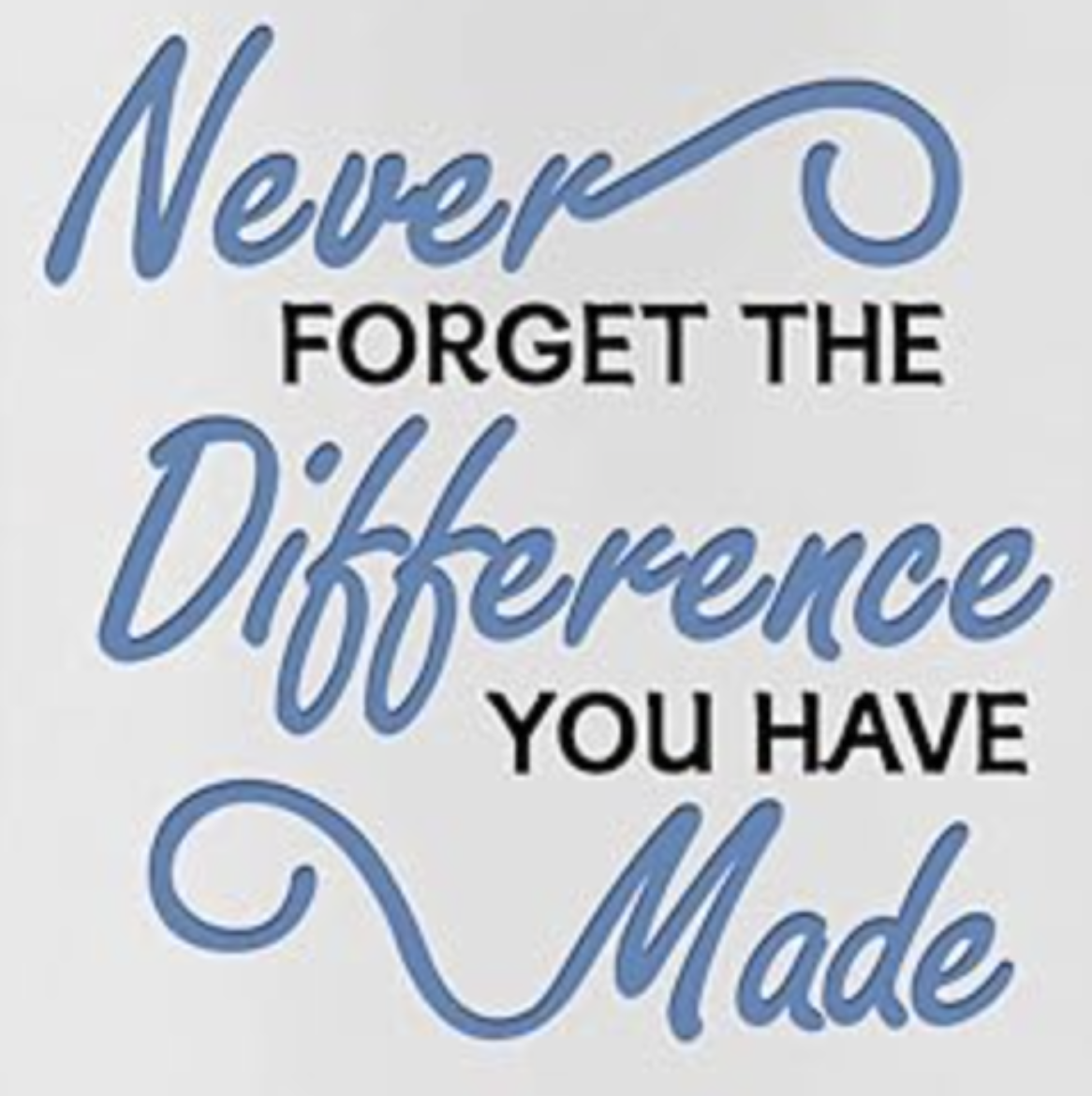
THANK YOU for your professionalism and ongoing commitment to PMEA and our profession. As we commemorate our country’s 250th anniversary and celebrate PMEA’s upcoming 100-year milestone (in 2033?), let’s all “take to heart” the inscription on the PMEA retired member mugs: “Never forget the difference you’ve made!”

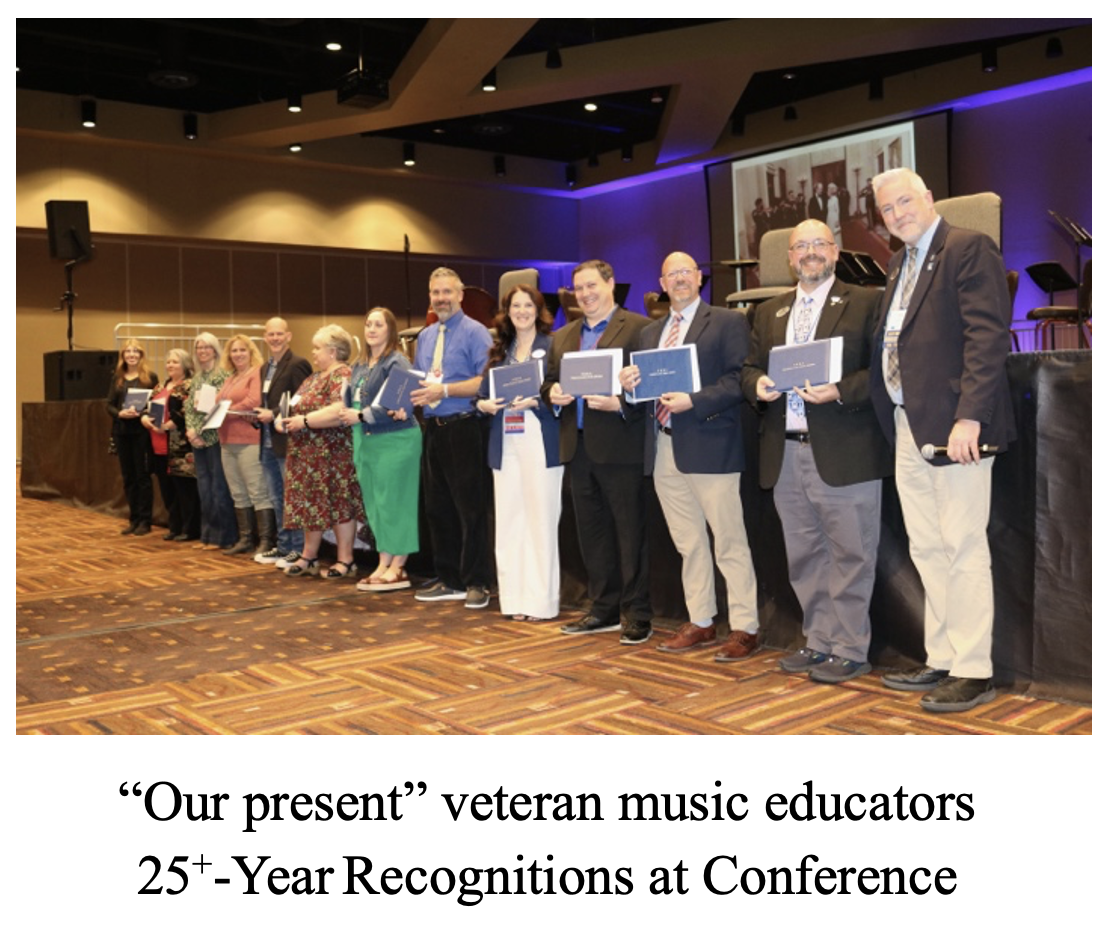
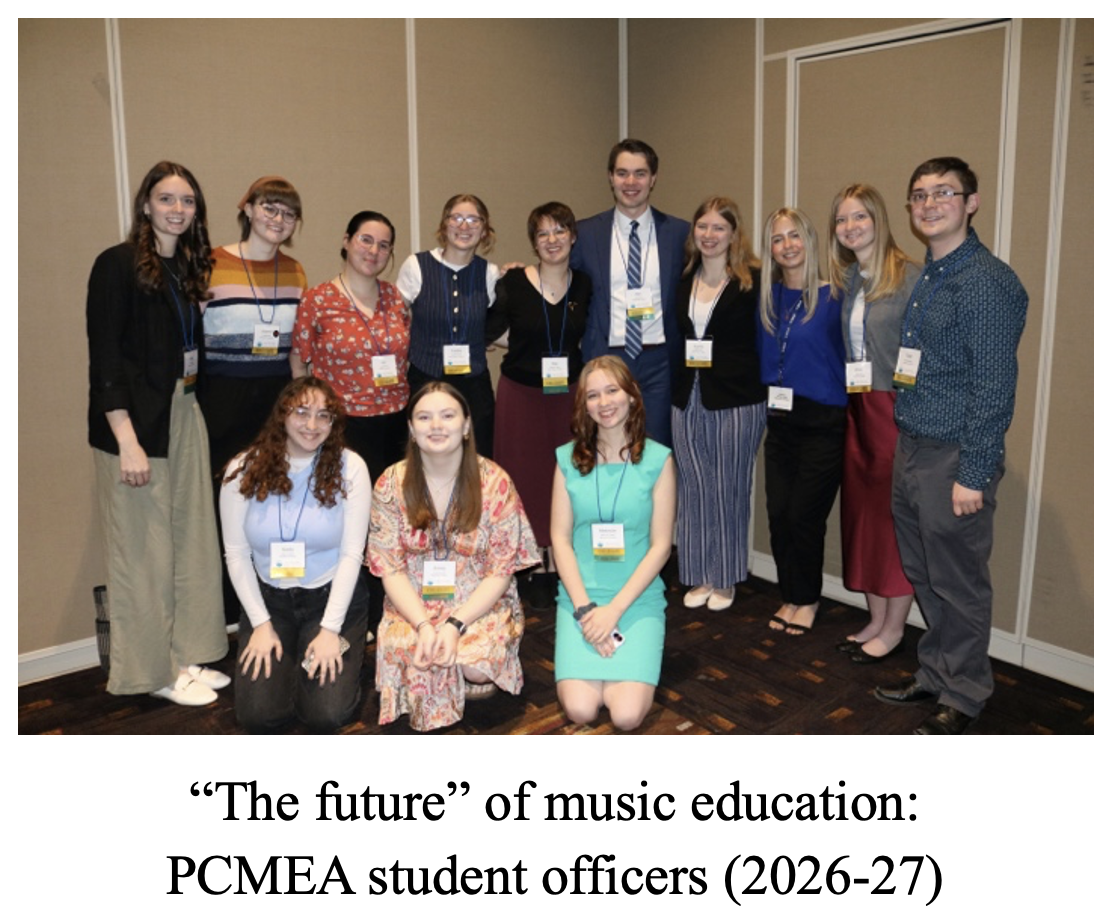
Circles of Life (in Music Education)

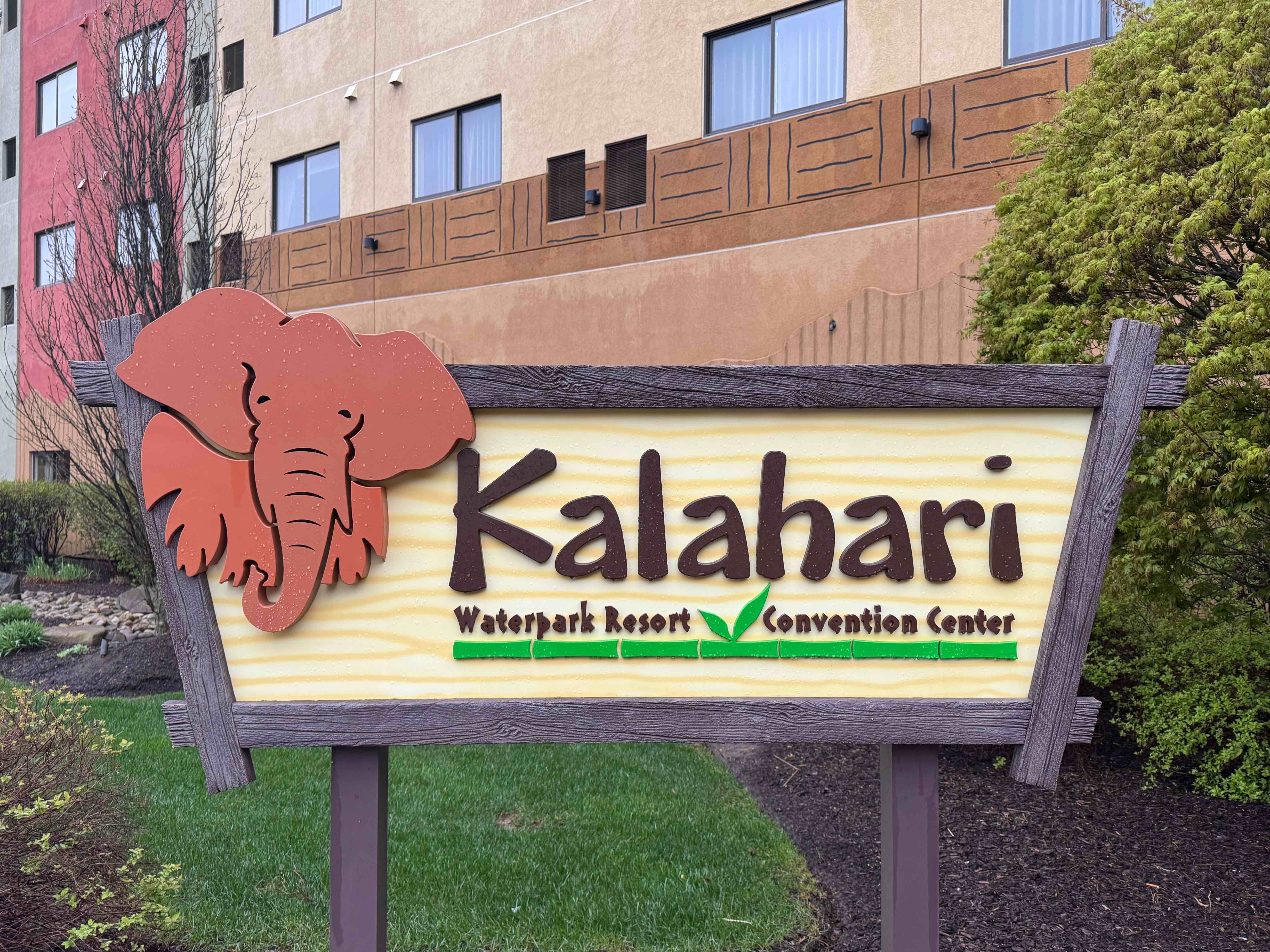
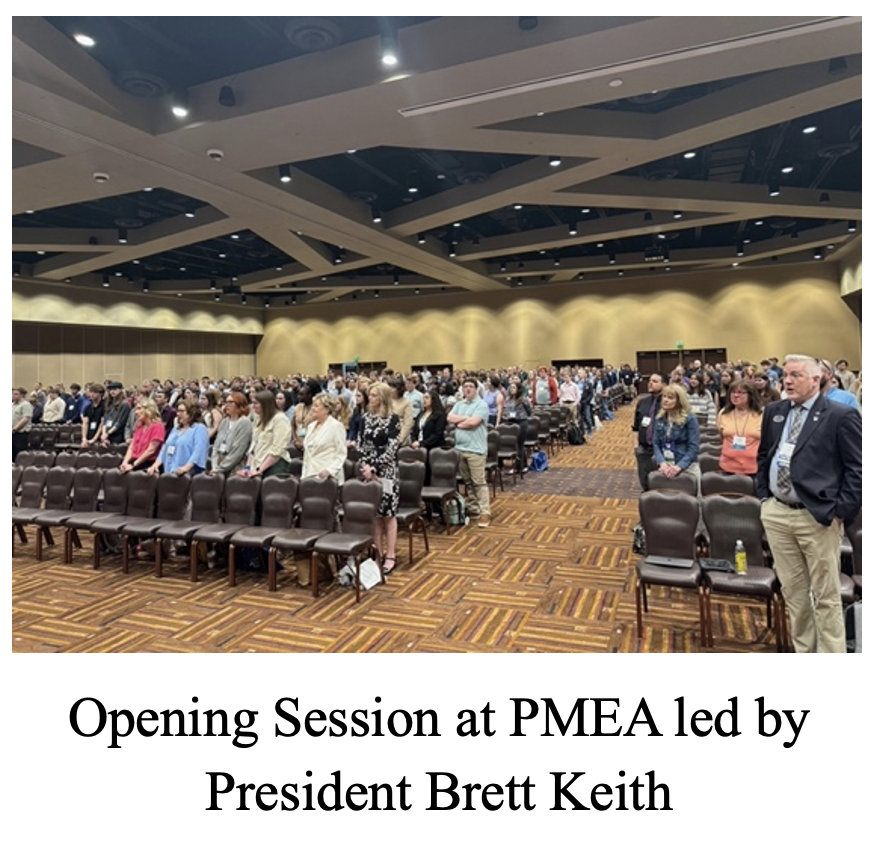
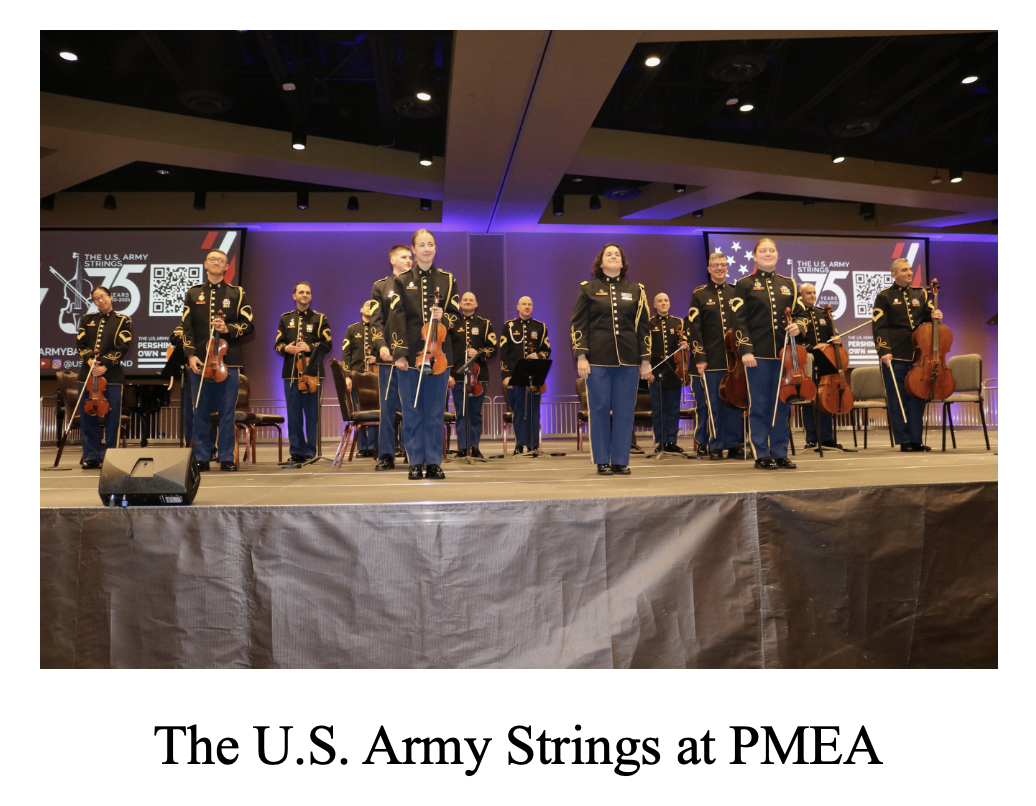
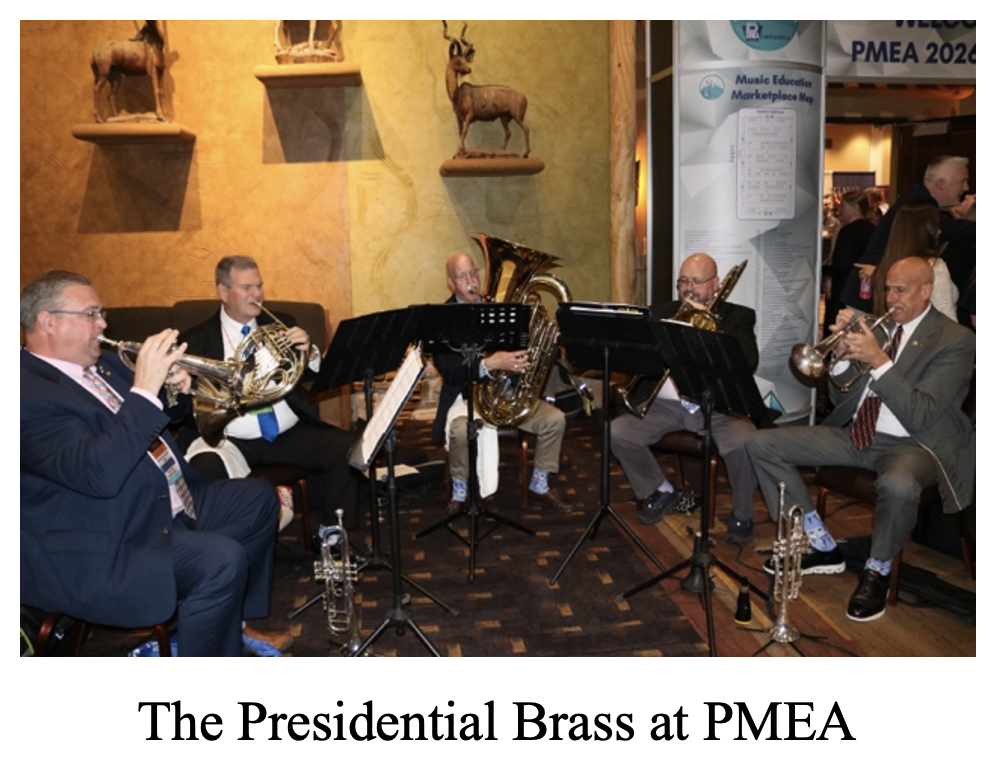
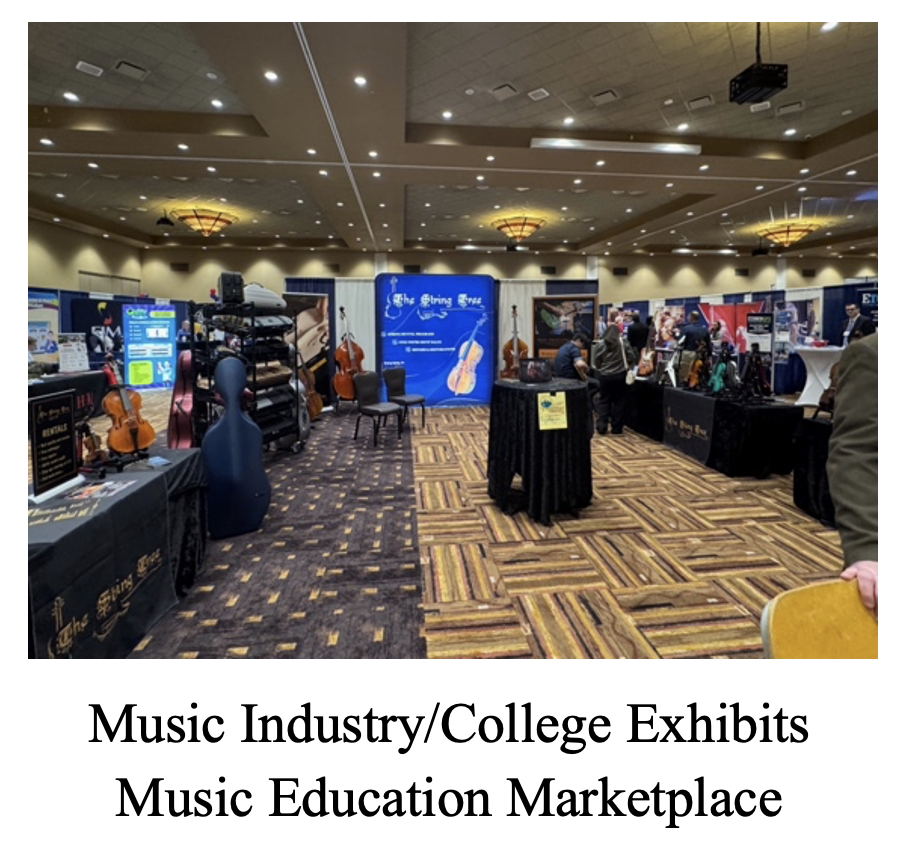
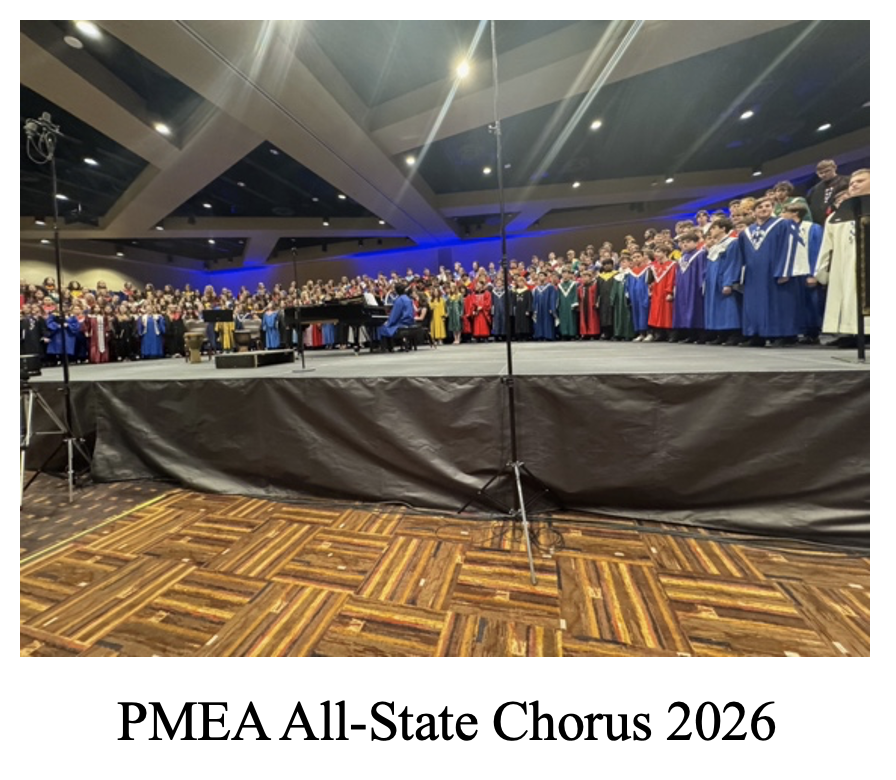
Photos from the PMEA Annual Conference at Kalahari, April 2026

Recap

For a follow-up, please peruse these past articles:

Click here for 874 more photographs from the most recent PMEA Annual Conference, Kalahari Resort in the Poconos, April 2026

PKF

© 2026 Paul K. Fox

How Musicians Can Grow Their Audience with Storytelling and Consistency

Guest Blog by Ed Carter

This month’s guest author’s submission is about creating, posting, and marketing digital music, something totally unfamiliar to me. However, Ed Carter’s focus on “storytelling” resonates in other fields. In past blog posts by yours truly, we have explored its application to the job interview process and provided strategies for prospective music educators to develop a consistent brand, marketing plan, and networking techniques for “selling” themselves (example here). Thanks Ed for your insights! PKF

Independent musicians building a career from their bedroom, rehearsal space, or local circuit often hit the same wall: the music is strong, but online presence growth feels random and exhausting. Posts disappear fast, algorithms feel fickle, and audience engagement challenges can make even consistent artists question their musician branding. Digital music marketing isn’t about being louder, it’s about being clearer and more repeatable so fans know what to connect with and come back for. With the right foundation, momentum stops depending on luck.

Understanding What “Consistent Storytelling” Really Means

The goal isn’t to post more. It’s to build a repeatable system that blends content consistency, simple storytelling, platform signals, and real fan interaction so your choices match how people actually follow artists. At the center is content consistency means your posts give a coherent impression, so new listeners instantly recognize what you’re about. Storytelling adds the human thread, and engagement turns casual scrollers into people who reply, save, and return.

This matters because guessing drains time and makes your growth feel like a slot machine. When your themes, formats, and cues stay steady, the algorithm and your audience both know what to do with your work. Think of it like a setlist. You keep a reliable structure, then rotate songs and stories to fit the room. With that framework, on-brand visuals become the fastest way to stay consistent.

Create Scroll-Stopping Visuals That Make Your Sound Look Like a World

Once your story is consistent, your visuals can do the heavy lifting of getting someone to stop and actually enter it. An AI art generator can help you turn the vibe of a song into bold, unexpected imagery that stands out in a crowded feed, think striking color palettes, surreal scenes, or character-driven art that makes people curious enough to tap, listen, and comment. Unique visuals don’t just look cool; they signal that your music has a point of view, which is exactly what earns attention across platforms. The real win comes from experimenting: try different styles, moods, and motifs until patterns emerge, and you’ll start to uncover a signature social aesthetic that fans recognize at a glance.

Capture → Tell → Schedule → Engage → Adjust

This workflow turns your song story into a repeatable audience building rhythm, so you are not reinventing your promo every time you post. It also keeps consistency from feeling like a grind by separating creative work, planning, and community time.

StageActionGoal
CaptureNote lyrics, themes, and one listener takeaway.A clear story hook for every post.
TellWrite 3 micro-stories: origin, meaning, and behind-the-scenes moment.Multiple angles from one song narrative.
ScheduleMatch each angle to one platform and posting day.Consistent visibility without daily scrambling.
PublishPost with one simple prompt question.Invite comments, saves, and shares.
EngageReply in batches, then pin one strong fan comment.Turn interaction into belonging and momentum.
AdjustReview what resonated and reuse winning formats next week.Compounding growth through small iterations.

A useful guide involves calming, feeling, thinking, doing, and reflecting, which mirrors how fans move from attention to connection to action. When you cycle through these stages weekly, storytelling stays coherent, and your consistency becomes predictable in a good way.

Weekly Habits for Story-Driven, Consistent Growth

Habits matter because they make your storytelling feel natural instead of forced, and they protect your time when life gets busy. When you repeat a few simple practices, your audience learns what to expect and you gain confidence showing up consistently.

The Two-Minute Story Capture

  • What it is: Jot one moment, emotion, and takeaway right after writing or practicing.
  • How often: Daily
  • Why it helps: You always have raw material for posts, even on low-energy days.

The Early-Start Content Buffer

  • What it is: Spread out the working process by drafting posts before release week.
  • How often: Weekly
  • Why it helps: A buffer reduces stress and prevents last-minute, rushed promo.

Three-Part Story Rotation

  • What it is: Rotate origin, meaning, and behind-the-scenes as your repeating content pillars.
  • How often: Weekly
  • Why it helps: One song fuels multiple posts without feeling repetitive.

One Clear Conversation Prompt

  • What it is: End each post with a simple question fans can answer in one sentence.
  • How often: Every post
  • Why it helps: More replies signal connection and keep your comments section alive.

Batch Reply and Pin

  • What it is: Respond in two short windows, then pin one thoughtful fan comment.
  • How often: Twice weekly
  • Why it helps: You build belonging without being online all day.

Build a Steady Audience with Story, Presence, and Routine

It’s easy to feel stuck when great music meets an inconsistent posting schedule and a scattered online footprint. The way through is simpler than it sounds: lean on storytelling and consistency, anchored by a clear digital presence summary that makes it easy for new listeners to find, trust, and follow. When that rhythm holds, empowering musicians online stops being a slogan and starts becoming a reliable process for consistent audience growth and real connection. Consistency turns attention into trust, and trust turns listeners into fans. Choose one repeatable growth strategy for the next 7 days, one small story you can share the same way each day, and let it run. That kind of steady momentum builds resilience, confidence, and a healthier creative life long after the algorithm shifts.

© 2026 Ed Carter and Paul K. Fox

Stamp Out the PHOBIA of Amateur Music-Making

Expanded from “Recreational Music-Making,” published in the Fall 2024 UPPER ST CLAIR TODAY magazine.

The definition of a “phobia” is “an anxiety disorder involving excessive and persistent fear of a situation or object.” It is known that exposure to the source of the fear may trigger an immediate anxiety response. And, according to the National Institute of Mental Health, approximately 12.5% of adults in the U.S. will deal with a specific phobia in their lifetime.

Some of the most common phobias include arachnophobia (fear of spiders), acrophobia (fear of heights), aerophobia (fear of flying), claustrophobia (fear of enclosed spaces), mysophobia (fear of germs), and trypanophobia (fear of needles), to name a few.

But why on earth do we have a “fear of amateur music-making?”

Okay, I doubt there is any true rational cause for anyone to be afraid of picking up an instrument or singing in a group, except for a touch of stage fright (if it’s in public) or that always-present “fear of failure” (possibly resisting the urge to make a fool of ourselves?). But, making music or opening ourselves up to creative self-expression is one of the greatest gifts we have to personally experience and share. No one hesitates to play a game of cards, catch a ball, or swim with the kids… even if “we are not all that good at it!” So, why are some adults so reticent about letting down their hair, finding and dusting off that old band or string instrument in the attic, warming up their “chops,” brushing up on the fundamentals, and playing a few notes? Remember all the fun you had in school music? (Sure, you might be more than a little rusty, but that’s understandable. Do you recall your music teacher’s instructions on how to hold the instrument, read the notes, and “find” the fingerings? It’s not too hard to re-orient and recapture those early steps.)

We can and should be inspired by those breathtaking performances of professional musicians, singers, dancers, and actors – their amazing artistry always looks and sounds so perfect! But are you telling me that art is only for the virtuosos, maestros, or experts? No, music is for everyone! It is timeless and does not discriminate by age. It offers meaningful life-long learning for all stages, past experiences, and ability levels.

As if you really need stats to prove the benefits of music, please peruse the NAMM Foundation website here: https://www.nammfoundation.org/articles/2014-06-01/Benefits-learning-and-playing-music-adults. They quote “the value of recreational music-making to be scientifically proven” to help the U.S. workplace by reducing employee stress, depression, burnout, and improving worker retention. In addition, as a music teacher and former school choral and orchestra director, I frequently share this quote by Don McMannis in “Use Music to Develop Kids’ Skill and Character” from the March 19, 2009 online post of Edutopia:

“Music has positive effects on people’s emotions and creativity. When we sing together, we synchronize our breathing and feel more connected. Music is also an effective, almost magical medium for learning and retaining information, [because] it activates three different centers of the brain at the same time: language, hearing, and rhythmic motor control. By inducing emotions, it also creates a heightened condition of awareness and mental acuity…”

As for “us seniors,” there are so many amazing benefits of music lessons throughout our “golden years!”

  1. Cognitive well-being (“reduce the risk of cognitive decline…”)
  2. Emotional resilience (“provide a powerful outlet for self-expression and emotional release…”)
  3. Physical benefits (“improve motor skills, enhance coordination, increase overall physical activity…”)
  4. Stress reduction (“therapeutic escape from daily worries… relax and unwind…”)
  5. Lifelong learning (“promote a sense of ongoing personal growth… the joy of learning and mastering new techniques…”)
  6. Social connection (“bringing people together… combat social isolation… and create a sense of belonging.”)

Check out additional information at the New York Musician’s Center blog here: https://nymcmusic.com/f/the-remarkable-benefits-of-music-lessons-for-senior-citizens

Truly, you have no valid excuses! I am guessing there are many community choral, jazz, band, and orchestra ensembles inside and outside the surrounding areas where you live. And don’t forget to consider visiting a local church to join their choir!

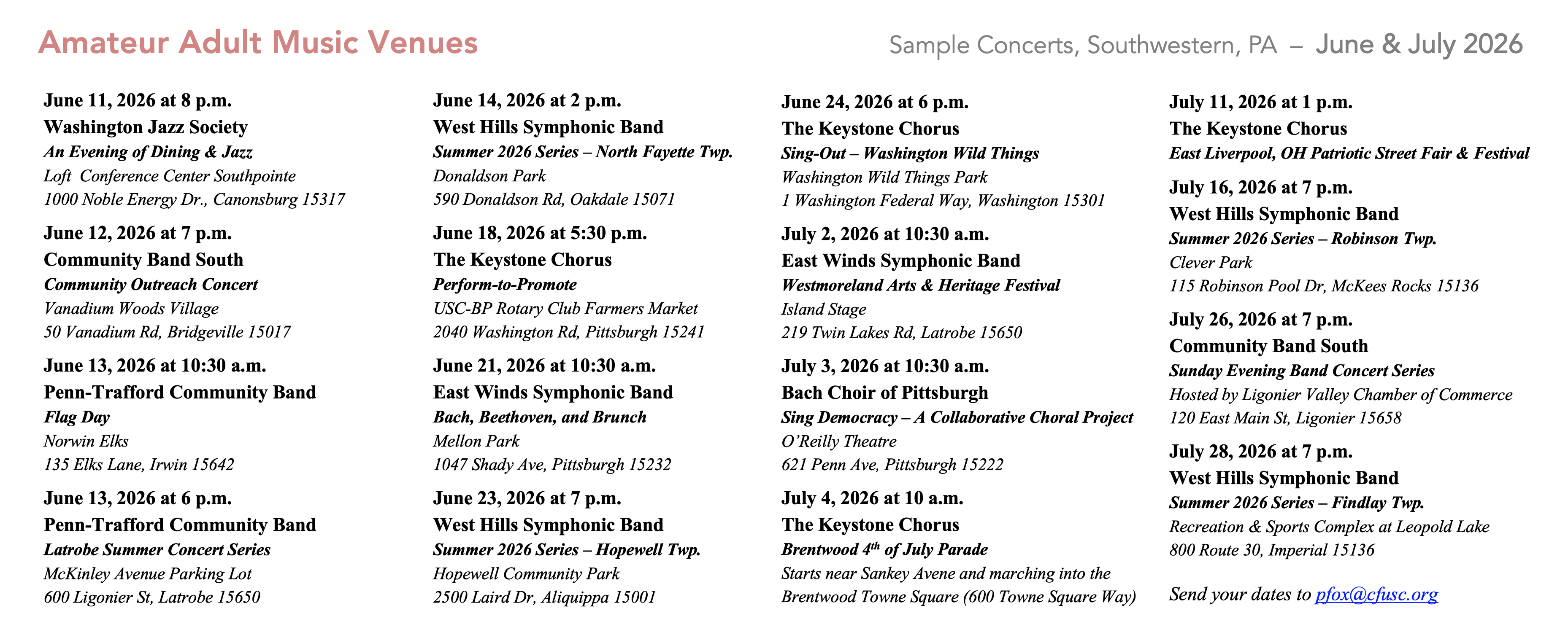
In the southwestern Pennsylvania area where I reside, there are numerous opportunities for getting involved in adult amateur music, art, dance, and drama venues. I have the links to 20 ensembles from the Greater Pittsburgh area alone on the Community Foundation of Upper St. Clair Arts page here. Take a look at a few of their upcoming June and July concerts below.

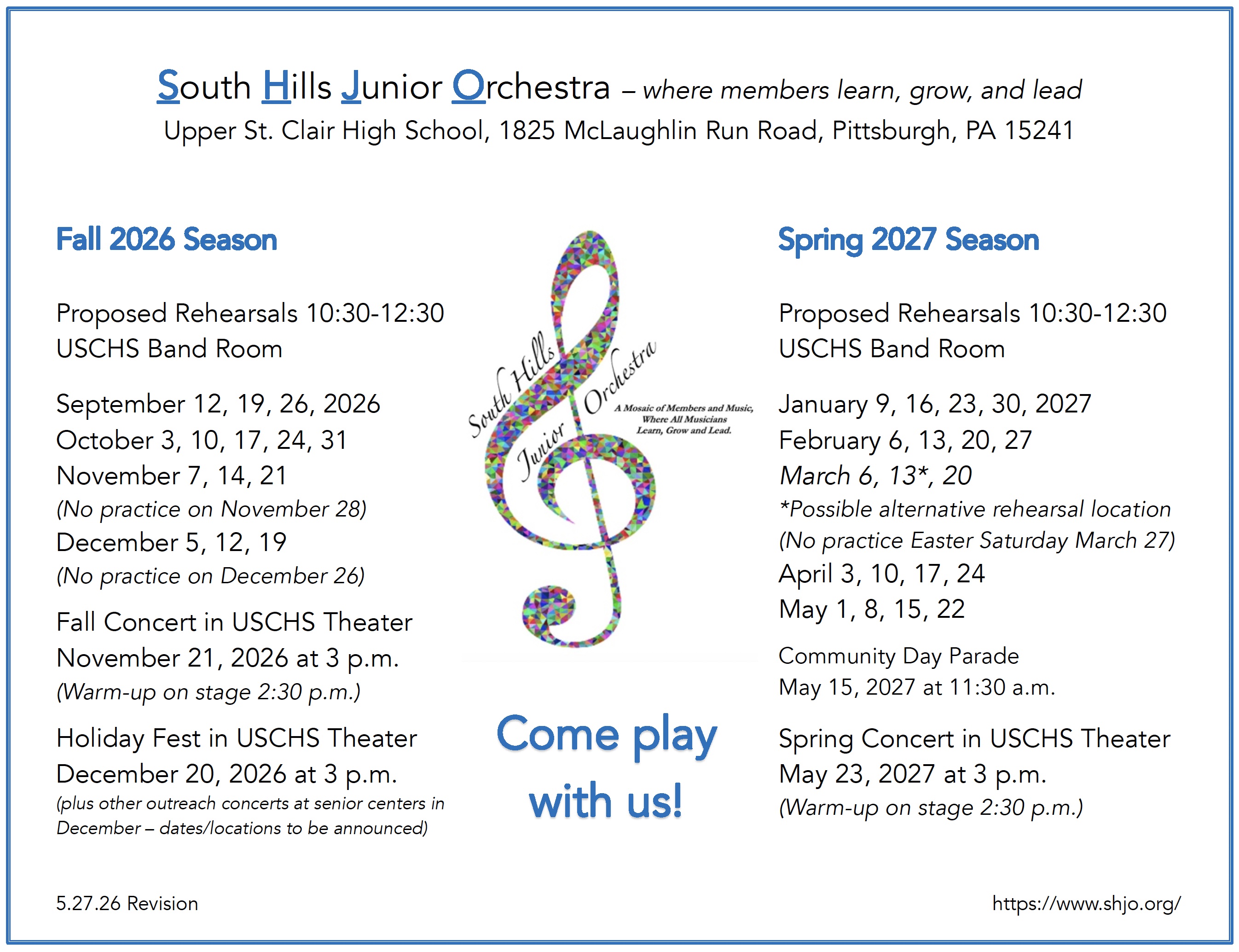
This fall, adults and “music lovers of all ages” should drop-in to several open, free-trial, no-obligation-to-join rehearsals of the South Hills Junior Orchestra (SHJO) on Saturdays from 10:30 a.m. to 12:30 p.m. in the Upper St. Clair High School (USCHS) Band Room. After the successes of SHJO’s annual spring concert on May 23 and a community outreach performance at the Paramount Senior Living Facility in Peters Township on May 30, we’re taking a break over the summer. But mark your calendars! Our next practice is scheduled for September 12, 2026. Here are our proposed dates for 2026-27:

If you live in the South Hills/Pittsburgh area, musicians are also invited to another group that rehearses at USCHS, the Community Band South (adults only). Directed by Max Gonano, CBS meets most Monday evenings at 7:30 p.m., even over the summer months! Bring your instrument!

The next time you host a dinner party, bring out that old song book or pick up your fiddle or flute! Gather around the piano and encourage your family and friends to join in a sing-along. Hopefully it does not take a few glasses of wine before everyone can shed their inhibitions and relax a little… and enjoy the incredible effects of communal music-making! What do you have to lose? There’s no time like the present!

Stamp out the phobia of amateur music-making!

PKF

© 2024, 2026 Paul K. Fox

The Four Rs of Music Education

Reflection, Reinvention, Retreat, and Restoration

Guest post by Katherine Langford

We welcome the return of guest blogger Katherine Langford, who offers insights on how music education nurtures creativity, balance, and lasting passion for learning. Her last article was “The New Model of Modern Music Education” (2025). She describes herself as “a digital marketing consultant, writer, freelancer, WordPress enthusiast, and coffee lover.” Thank you, Katherine! PKF

Music education is more than just learning notes, scales, and chords. It’s about growth, creativity, and self-discovery. Whether you’re a student, a teacher, or a lifelong learner, the journey of music unfolds through cycles of learning and renewal. The concept of the Four Rs of Music Education: Reflection, Reinvention, Retreat, and Restoration beautifully captures this ongoing process.

These four principles help musicians reconnect with their passion, refine their skills, and rediscover purpose. Let’s explore how each “R” plays a role in shaping better musicians, educators, and learners—both in classrooms and in online class help settings where flexibility meets creativity.

Reflection in Music Education

Reflection is the first step toward genuine growth in music. It’s about looking back to understand what worked, what didn’t, and what could improve. Musicians often rush through practice sessions, but without reflection, progress stalls.

Reflecting on past performances helps identify patterns and habits. Maybe your rhythm feels slightly off, or your phrasing needs more emotion. When students pause to think about their experiences, they start connecting technique with meaning. This process deepens understanding beyond mere repetition.

For teachers, reflection shapes lesson plans and teaching styles. It’s not just about evaluating students but also self-assessing methods. Asking questions like, Did my students grasp the concept? Could I have explained it better? opens new possibilities.

Practical reflection can include journaling after lessons or recording performances to analyze later. Even in music education online, where feedback may seem distant, reflection bridges that gap. Students who revisit recordings of their practice can hear their growth over time.

Reinvention in Music Education

Once reflection takes place, the next step is reinvention. Reinvention is where creativity flourishes. It encourages musicians to reshape their identity, experiment with new techniques, and explore unfamiliar styles.

Every musician reaches a plateau. Reinvention helps overcome it. Trying different genres, instruments, or teaching methods revitalizes motivation. A classical pianist might explore jazz improvisation, or a vocalist might learn digital music production. These changes broaden understanding and strengthen adaptability.

In music education, reinvention keeps learning exciting. Teachers who incorporate technology, apps, or virtual performances engage students better. Reinvention also applies to learners using online class help platforms. They can explore theory, composition, or ear training with tailored support, matching personal learning speeds.

A big part of reinvention is embracing mistakes. Growth often comes from stepping outside the comfort zone. Students who reimagine failure as feedback develop resilience. Music thrives on such transformation. Reinvention keeps passion alive, no matter how many years someone has played.

Retreat in Music Education

Retreat might sound like stepping away, but in music, it’s a necessary pause. Taking breaks gives musicians time to breathe, reset, and process what they’ve learned. Creativity demands rest as much as effort.

Many students push themselves to practice endlessly. Yet over-practicing can lead to burnout or injury. A strategic retreat helps restore energy and focus. Stepping back for a while often leads to stronger comebacks. It’s similar to letting silence enhance the beauty of a melody.

Teachers also benefit from retreating. When educators allow time for reflection and relaxation, they return with renewed enthusiasm. This creates a more balanced environment for both themselves and their students.

Retreats don’t have to be long. A short pause between lessons, a quiet walk, or even a few mindful breaths before playing can make a difference. In music education, retreats remind learners that music isn’t just performance—it’s also presence.

Even students studying through online class help programs can benefit from short retreats. Logging off for a day or switching focus from performance to listening exercises can refresh the mind. This pause often leads to more meaningful progress later.

Restoration in Music Education

Restoration is where renewal begins. After reflection, reinvention, and retreat, musicians rediscover their connection with music. It’s the emotional and spiritual healing that brings purpose back into playing or teaching.

In music education, restoration often comes through rediscovering joy. When practice feels heavy, restoring one’s motivation means reconnecting with why music mattered in the first place. Listening to old favorites, collaborating with others, or simply playing for pleasure can spark that feeling again.

For teachers, restoration also means finding balance between structure and spontaneity. Students sense when their instructor feels inspired. Restored energy flows naturally into lessons, making learning more engaging and alive.

Restoration also ties into self-care. A healthy mind and body fuel creativity. Simple habits—staying hydrated, taking breaks, and celebrating small wins—help musicians sustain passion over time. Restoration is not a one-time event but a recurring phase in every artist’s journey.

Even in digital learning, restoration is vital. Students using online class help platforms can restore focus by revisiting the joy of learning, rather than rushing toward exams or performance goals. With patience and care, their progress becomes both steady and fulfilling.

Why the Four Rs of Music Education Matter

Together, the Four Rs—Reflection, Reinvention, Retreat, and Restoration—form a continuous cycle of artistic and personal growth. They keep music education holistic, addressing both skill and soul.

This framework encourages balance. Instead of chasing perfection, it invites progress and peace. Each “R” nurtures a different part of the learning experience:

  • Reflection builds awareness.
  • Reinvention fuels creativity.
  • Retreat restores clarity.
  • Restoration renews passion.

When integrated into daily practice, these principles prevent burnout and promote sustainable growth. Whether in traditional classrooms or through online class help, the Four Rs offer a roadmap for lifelong musicianship.

How the Four Rs Apply to Online Learning

Modern music education extends far beyond physical classrooms. Online platforms allow students to learn instruments, theory, and composition from anywhere. Yet, this shift brings new challenges. Maintaining motivation and connection can be harder in virtual spaces. That’s where the Four Rs come in.

  • Reflection helps students assess progress through recorded lessons and digital assignments.
  • Reinvention encourages exploring online tools like digital keyboards or rhythm apps.
  • Retreat prevents screen fatigue by balancing screen time with hands-on practice.
  • Restoration ensures students stay inspired by joining online communities and virtual performances.

Using these principles keeps learning balanced, even in a fast-paced digital world. Whether a student says, “I need someone to take my online class,” or just wants extra support, embracing the Four Rs ensures the journey remains meaningful.

Common Reader Question: How Can Music Students Stay Motivated Long-Term?

Many learners wonder how to stay motivated when progress feels slow. The answer lies in the Four Rs. Reflection shows how far you’ve come. Reinvention keeps practice exciting. Retreat helps avoid burnout. Restoration renews joy when motivation fades.

Music is a lifelong pursuit, not a quick achievement. Balancing effort and rest keeps the journey enjoyable. Motivation isn’t constant, but using these principles ensures it always returns.

Practical Ways to Apply the Four Rs in Music Education

Let’s look at simple ways to bring the Four Rs into practice for both students and teachers.

  1. Daily Reflection: Spend five minutes after each session writing what worked and what didn’t.
  2. Creative Reinvention: Try a new piece or improvise on a familiar melody weekly.
  3. Mini Retreats: Take short breaks after intense sessions to refresh your focus.
  4. Emotional Restoration: Listen to music that inspired you to start learning.

Teachers can also schedule reflection days or host open discussions about learning challenges. For online learners, creating digital journals or participating in peer reviews builds community.

The Four Rs and Emotional Wellbeing

Music doesn’t exist in isolation. It’s deeply tied to emotion and identity. The Four Rs not only shape better musicians but also healthier humans. Reflection teaches self-awareness. Reinvention builds confidence through experimentation. Retreat prevents burnout. Restoration fosters gratitude and peace.

This emotional balance benefits students and teachers alike. When lessons include empathy and patience, the environment becomes nurturing. Learning music becomes a joyful experience rather than a stressful task.

Bringing the Four Rs into the Classroom

Incorporating these principles into music education doesn’t require a full curriculum overhaul. Small steps make a big difference. For example, dedicate time for students to reflect after performances or introduce creative projects that allow reinvention.

Encourage retreats during exam periods, reminding students that rest improves retention. Use restoration activities such as group jam sessions or collaborative projects to reignite enthusiasm.

Even in virtual classrooms, teachers can use reflective discussions, creative challenges, and feedback sessions to make learning more interactive. The Four Rs build a culture of respect and curiosity, which every classroom needs.

Why Balance Is Key in Music Education

Balance keeps passion alive. Musicians who only focus on technical mastery risk losing emotional connection. Those who only chase creativity may neglect discipline. The Four Rs bring equilibrium by blending introspection, experimentation, rest, and renewal.

Music thrives when learners stay curious and teachers stay inspired. Balance ensures that both continue growing. Whether through physical practice or online class help, balance transforms learning into a rewarding, lifelong adventure.

Conclusion

The Four Rs of Music Education: Reflection, Reinvention, Retreat, and Restoration remind us that music is not just about sound. It’s about growth, emotion, and connection. These principles guide musicians to learn deeply, teach wisely, and live creatively.

Every stage of music education benefits from these cycles. Reflection helps you understand your progress. Reinvention sparks creativity. Retreat allows you to pause and recharge. Restoration brings your heart back into music.Whether you’re attending lessons in person or seeking online class help, applying these Four Rs ensures that your musical journey stays balanced, joyful, and deeply human.

© 2026 Katherine Langford and Paul K. Fox
Boosters – Part 2

Clearinghouse of Corroborative Materials for
IT TAKES A VILLAGE

Booster Session at the Annual PMEA Conference

We hope you had the opportunity to attend our booster brainstorming session on Saturday morning at the 2026 PMEA Annual Conference in Kalahari/Poconos. This previous blog-post references the IT TAKES A VILLAGE workshop’s description, objectives, and “hot topics” to help lead collaborative discussions among the attendees. It is our hope that in future conferences, we will schedule additional venues to share local strategies and “best practices” to build numbers and the engagement of its booster members, improve their overall effectiveness and efficiency, “re-energize” their support groups’ mission, vision, goals, and action plans, and provide tips and tools to guide their associations’ motivations, actions, and legal compliance.

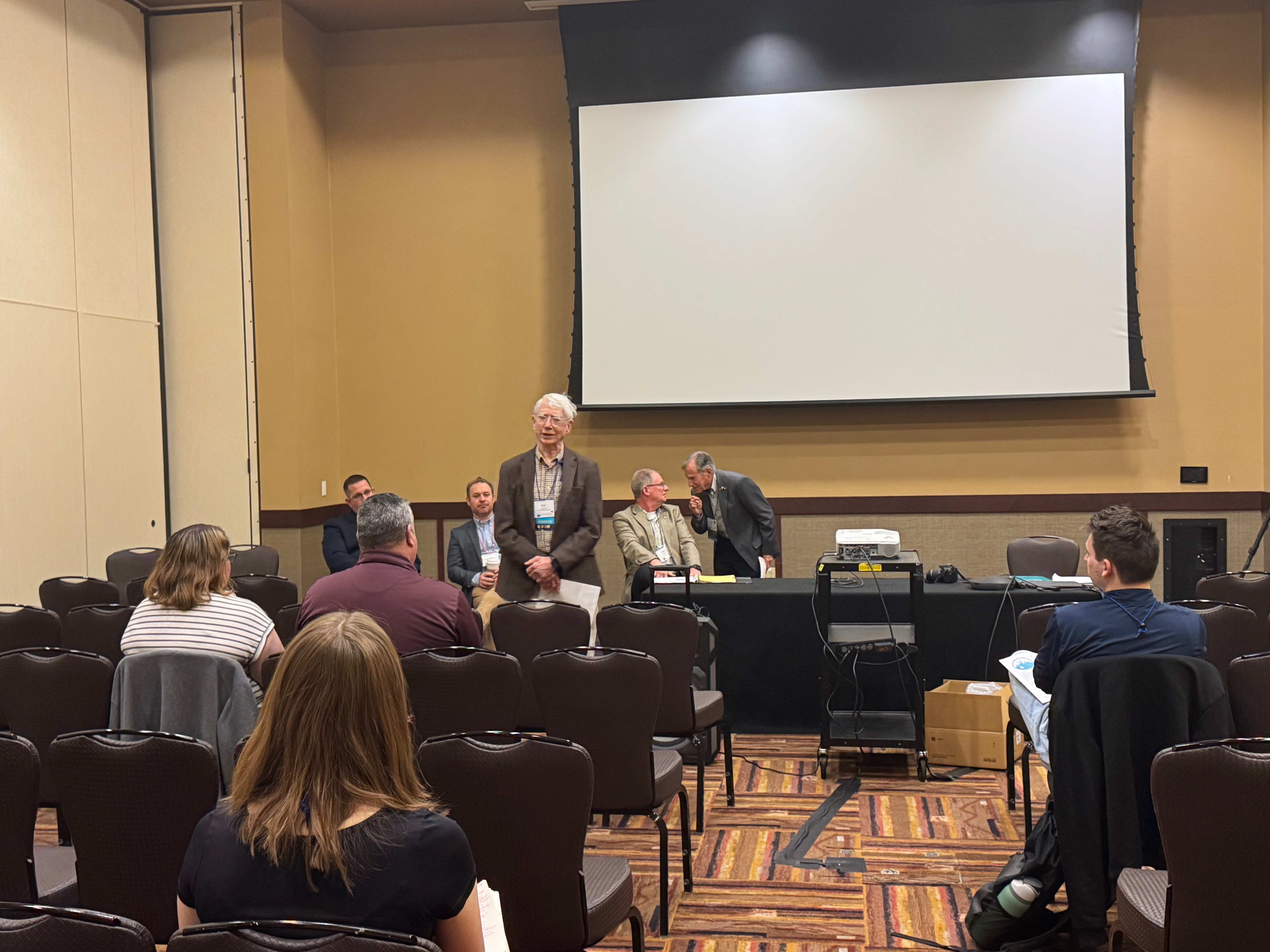
Dr. Robert Dell and panelists address attendees at the IT TAKES A VILLAGE Booster Sharing Session on April 25, 2026 during the PMEA Annual Conference.

These were the handouts and samples distributed on April 25, 2026. They are reprinted here with the permission of the authors, members on the session’s guest panel (and many of whom have presented on this subject at past conferences).

When they become available, additional files will be posted for download in the space below.

If you have boosters materials you are willing to share here, please send files to paulkfox.usc@gmail.com.


Two References on “Music Boosters”

If you are planning to start or enhance your own school music support group, consider a purchase of these publications (Amazon):

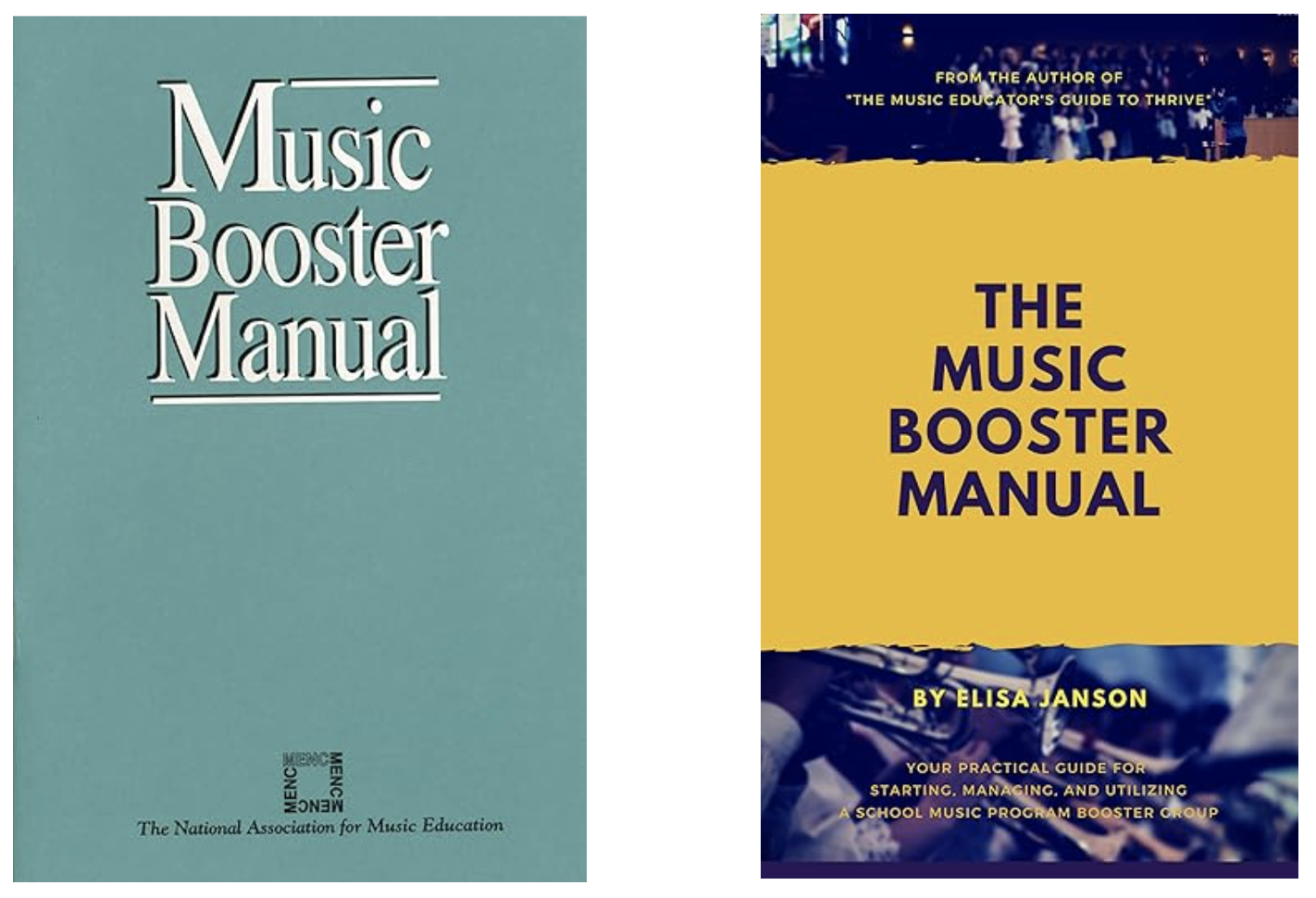
Music Booster Manual, published by MENC – The National Association for music Education (1989)

The Music Booster Manual: Your Step-by-Step Guide to Launching a Music Booster Group in Your School by Elisa Janson Jones Kindle Edition (2018)

Staying Connected… Across the Commonwealth

If you would like to sign-up to receive future emails of additional music parent/director support group resources, please click here. If there is sufficient interest, we will send out communications with additional research, forms, workshop handouts, etc.

Finally, if you have something you would like to share with the stakeholders (parents, directors, community members) of the PMEA music booster affiliates, send an email with Word or PDF files to paulkfox.usc@gmail.com (use subject line “boosters”).

PKF

© 2026 Paul K. Fox
Booster Brainstorming

Music Parents & Directors: Come to PMEA to Share Your Best Ideas!

It takes a village to “raise” a music student. Community support groups (boosters) are crucial for the success of sustaining Pre-K to Grade 12 band, choral, jazz, string, general music, Modern Band, and other school music programs. Across the country, we have seen that the best music programs seldom fail to attract supportive parents, alumni, administration, and community members at large. This makes creating and managing a booster program a particularly easy and attractive way to gain essential funding for establishing programs, and for providing the additional financial and educational resources to enhance the learning of students while increasing their opportunities to perform, travel, and experience music on a deeper level.

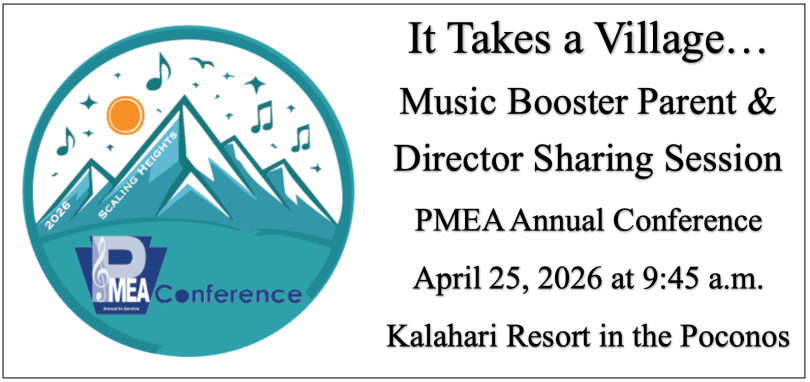
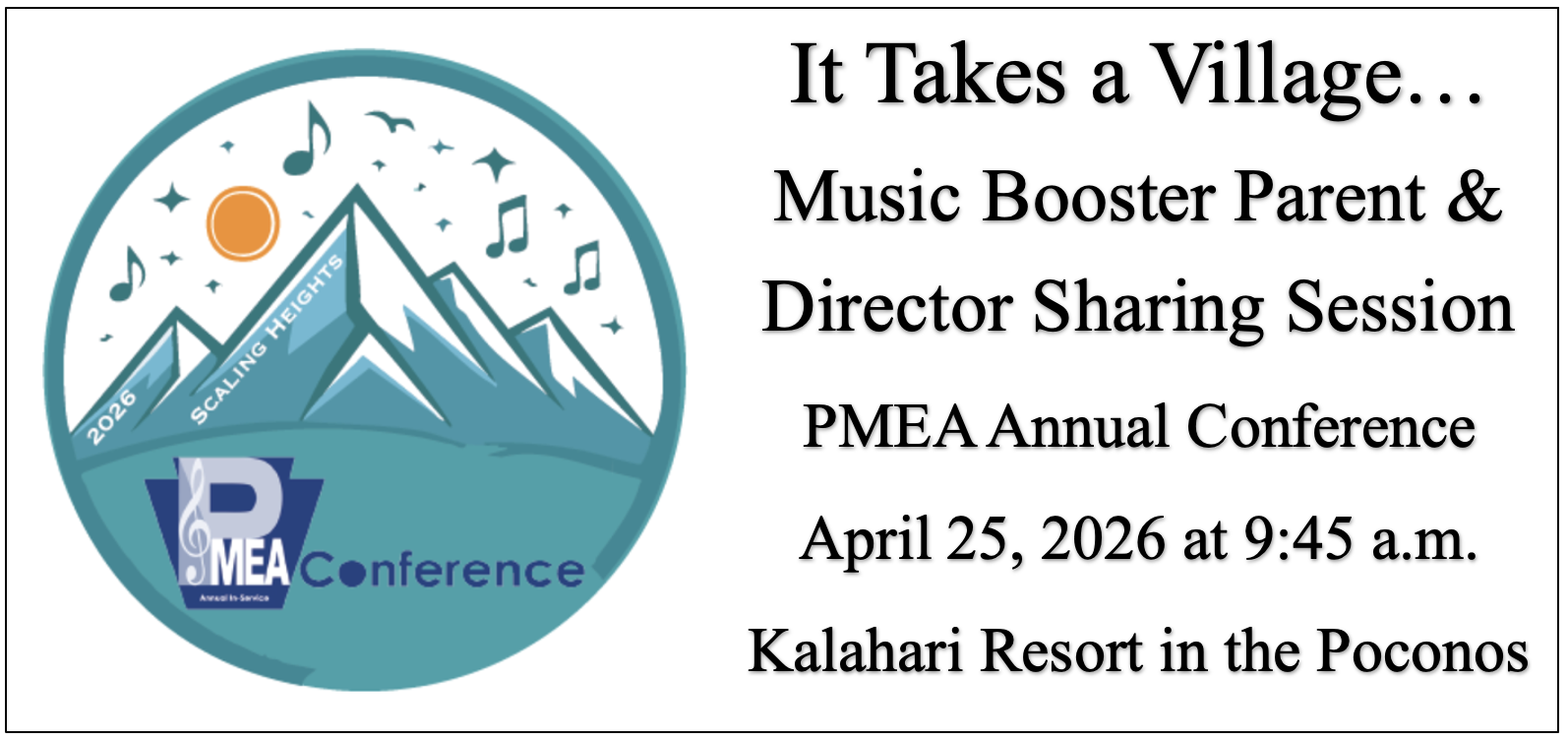
There’s power in numbers, so we’re calling on all music parents and directors to sit down, put our heads together, and talk! On April 25, 2026 during the PMEA Annual Conference at the Kalahari Resort in the Poconos, IT TAKES A VILLAGE… Music Booster Parent & Director Sharing Session will provide an informal forum for the participants to “let their hair down” and share their local strategies and “best practices” to build numbers and the engagement of its members, improve overall effectiveness and efficiency, “re-energize” their booster organization’s mission, vision, goals, and action plans, and help the boosters themselves with tips and tools to guide their organizations’ motivations, actions, and legal compliance.

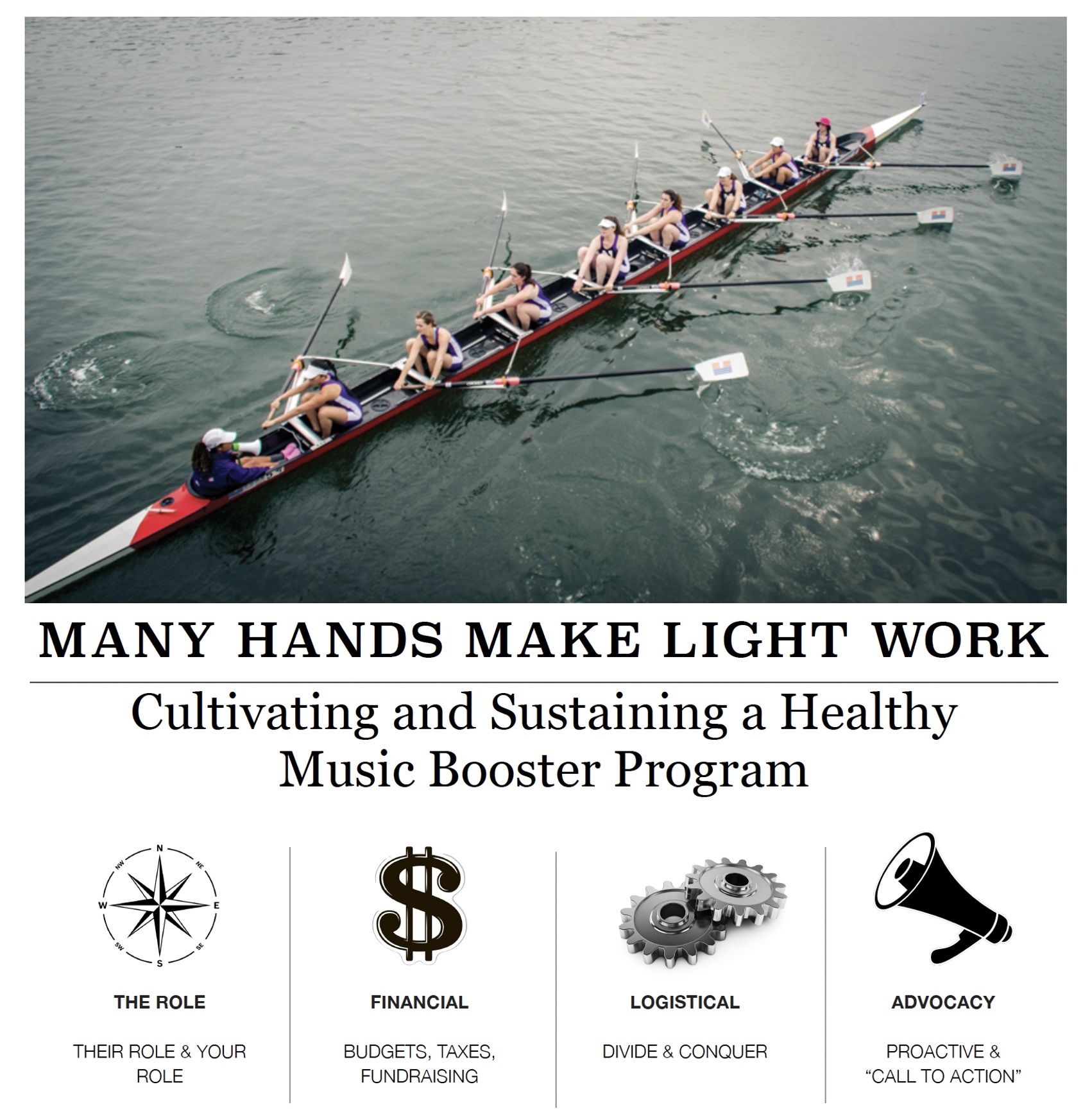
Navigating the Boat of Brainstorming

We’ve invited an “expert” guest panel with vast experience managing their own parent booster groups will help steer the conversation towards pragmatic solutions to common issues (as many of these will be addressed as time allows):

  • Robert Dell (Carnegie-Mellon University and retired from Peters Township SD)
  • Donna Fox (Carnegie-Mellon and retired from Peters Township SD)
  • Paul Fox (PMEA Council for Teacher Training, Recruitment, and Retention and retired from Upper St. Clair SD)
  • Len Lavelle (North Hills SD)
  • Christopher Marra (Seton Hill University)
  • Henry Pearlberg (retired from Wallingford-Swarthmore SD) 
  • Rich Victor (University at Buffalo Graduate School of Education and retired from State College Area SD)

Hot Topics

As time allows, a free-flow of open, facilitated, interactive discussion by the attendees will be encouraged to share their experiences, problems and issues addressed, and “how we handled this” solutions for the group’s consideration. Each panel member will bring to the table their own specific recommendations and/or “pet peeves” for building a productive community advocacy group supporting the Pre-K-12 music program.

A. “The power of unity” + “strength in numbers” (assembling a unified support group, a “comprehensive K-12 music boosters” of collaboration, cooperation and interconnectedness – working towards a common goal for the music program)

B. “Understanding who you represent” (putting students first and eliminating personal agendas and biases)

C. “Staying in bounds” (the mission, vision, and job description of a music booster, and redirecting/deflecting/modifying the occasional bad attitudes of parents – “the director does not like my kid?” or “my daughter did not make drum major”)

D. “What’s the difference between a coalition and a political action group?” (defining perceived and actual individual vs. group action plans – and touching on the saying: “if you’re not at the table, you’re on the menu…”)

E. “The tools of advocacy” (tips, tools, and techniques on how to be an effective advocate)

F. “Managing the minutiae” (an “idea bank” or clearinghouse of common problems and solutions – storytelling of “how to get it all together” and “what works for us!”)

G. Other common issues (apathy and inertia: building parent member support and involvement, volunteerism and attendance to meetings; fundraising and “fun”raising, nonprofit vs. profit IRS tax status, etc.)

Session Objectives

Attendees (both booster parents and music teachers) will be able to share their combined knowledge, understanding, and “best practices” of:

  • Rationale for and methods to start, build interest and participation in, and sustain a Music Booster Group
  • Types and models of booster organizations
  • Recruitment of booster members and officers
  • Job descriptions of officers and committee chairs
  • Set-up and smooth operation of official full group meetings and committees (agendas)
  • Budgets and fundraising
  • Support of music group travel, adjudication festivals, award banquets, social activities, etc.
  • Communications and publicity
  • Advocacy of the local Pre-K-12 music programs and music education in general
  • Sample Constitutions & Bylaws
  • Sample policies and procedures
  • Sample forms (e.g., uniform management)

In addition, a “brainstormed” review of booster group problems/concerns and “what we do” suggestions will be aired which may also cover these timely hot topics:

  • Recruitment of volunteers
  • How to get people to show up to meetings
  • How to “help” not “hurt” the program
  • How to become a parent advocate of the total music program of the district
  • Fundraising and “fun”raising – what’s the difference and why you need both?
  • Differentiation of “boostering” vs. “directing” or going over the head of music teachers
  • The advantages and disadvantages of going “nonprofit”

The session is free and open to music parents, directors, and other supportive stakeholders. (Visit the registration desk for a badge.) It is scheduled for Saturday, April 25, 2026 from 9:45 to 10:45 a.m. in the Kalahari Resort (Poconos) Sagewood Room. Although all music boosters throughout the state are invited to attend this complimentary workshop, this works especially well for the “proud parents” of PMEA All-State participants who may be staying over in the area to attend the culminating All-State festival concerts.

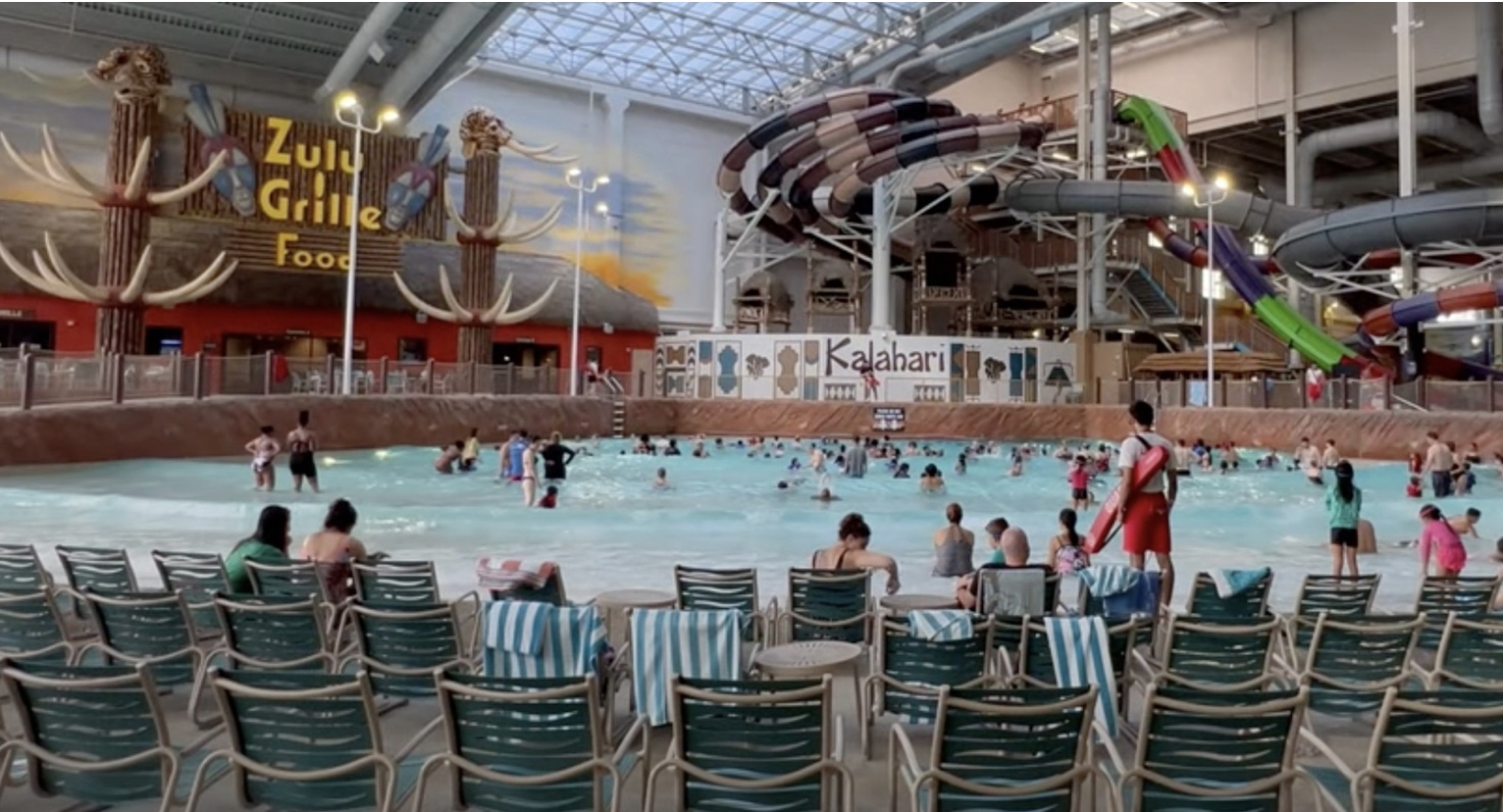
Besides… Here’s your reason to visit the Kalahari Resort website here, book a trip to the Poconos, and “get away from it all” during the last weekend in April, to enjoy the indoor water rides and slides, spa wellness/fitness services, resort shopping, the Kalahari Food (and not just) Wine Festival, and other family-friendly attractions.

PKF

© 2026 Paul K. Fox
5 Common Misconceptions About Chiropractors

Myths of Chiropractic Care

Those of you who follow these periodic blog-posts may remember my April 18, 2025 “rant” entitled “70 and Out? – Mobility!” If you have ever experienced severe back or neck pain, I recommend revisiting this piece and skeptics, also read the article below. My chiropractors literally “saved me!” In my opinion, better than any MRI/x-ray, weeks of standard physical therapy, or MD intervention (pills, shots or surgeries), the chiropractic care of George and his son Benjamin Fraudin offered me the fastest progressive recovery while guiding me to take “baby steps” towards less pain, better mobility and flexibility! They diagnosed the exact location of my compressed discs, manually adjusted my spine, and provided exercises to help me transition out of the acute phase of my sciatica. I’m coming up to my one-year anniversary of needing a cane, TENS machine, and the rental of an electric wheelchairs during the four-day PMEA Annual Conference at Kalahari Resort in the Poconos. THANK YOU, Fraudin Advanced Chiropractic and Rehab in Pittsburgh, PA.

The following guest post authored by Jeanett Tapia was shared by Intouch Chiropractic. Intouch Chiropractic is a boutique chiropractic practice in San Diego, CA, specializing in NUCCA upper cervical care, spinal decompression, and advanced therapeutic treatments. 

If you’ve spent any time researching ways to manage pain, improve your balance, or simply stay mobile as you get older, you’ve probably come across chiropractic care. And if you’re like many of us who’ve reached our retirement years, you may have also come across a reason not to try it, whether from a well-meaning friend, an outdated article, or simply an image stuck in your head of someone’s spine being violently “cracked” into submission.

Here’s the truth: many of the most persistent beliefs about chiropractic care are simply wrong. And those misconceptions may be quietly standing between you and a better quality of life.

Let’s clear the air.

Misconception #1: “Chiropractic care means painful cracking and twisting”

This is, by far, the most common reason seniors avoid exploring chiropractic care. The dramatic neck-snap you’ve seen on TV or heard about secondhand bears little resemblance to what many modern chiropractic practices actually do.

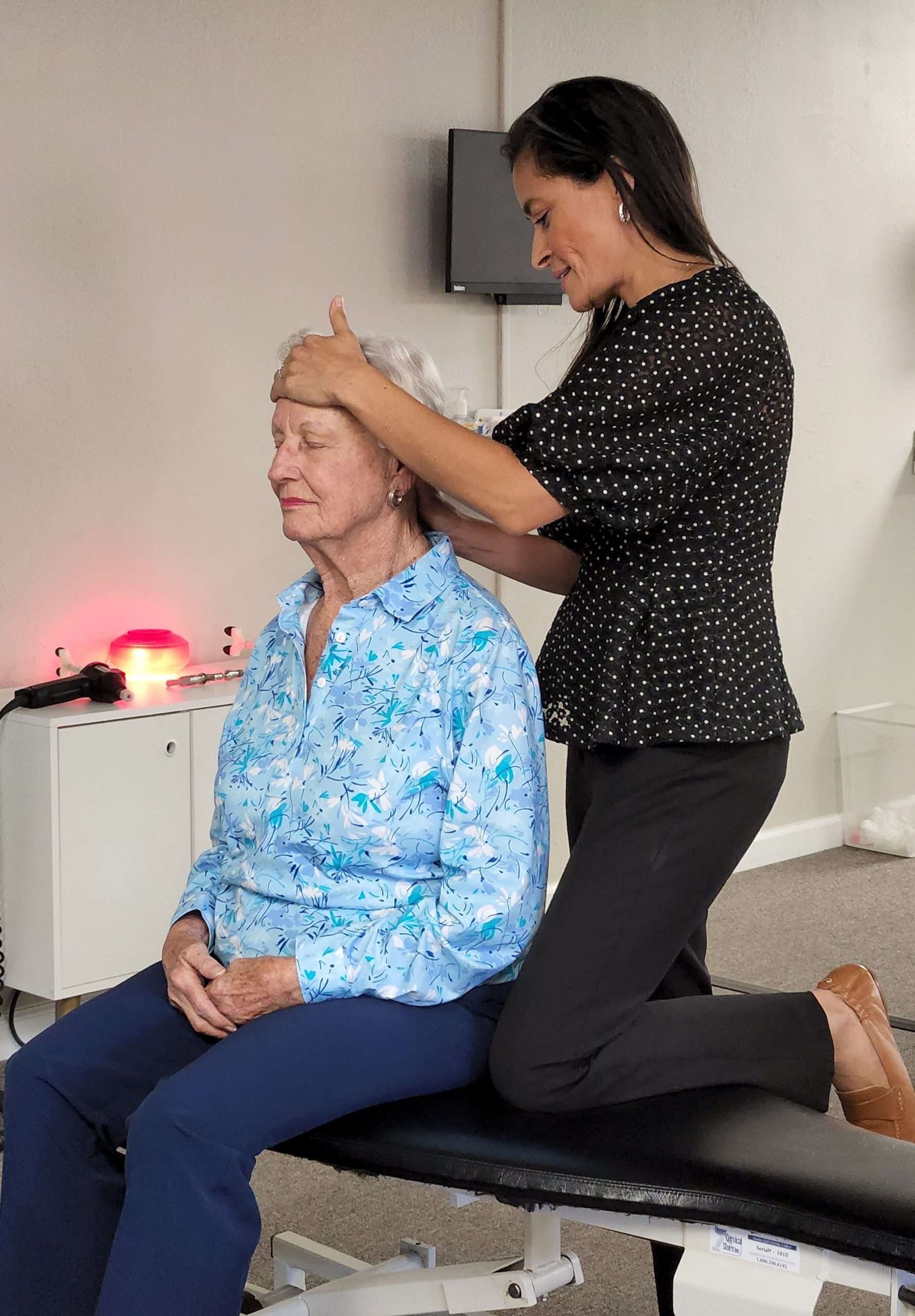
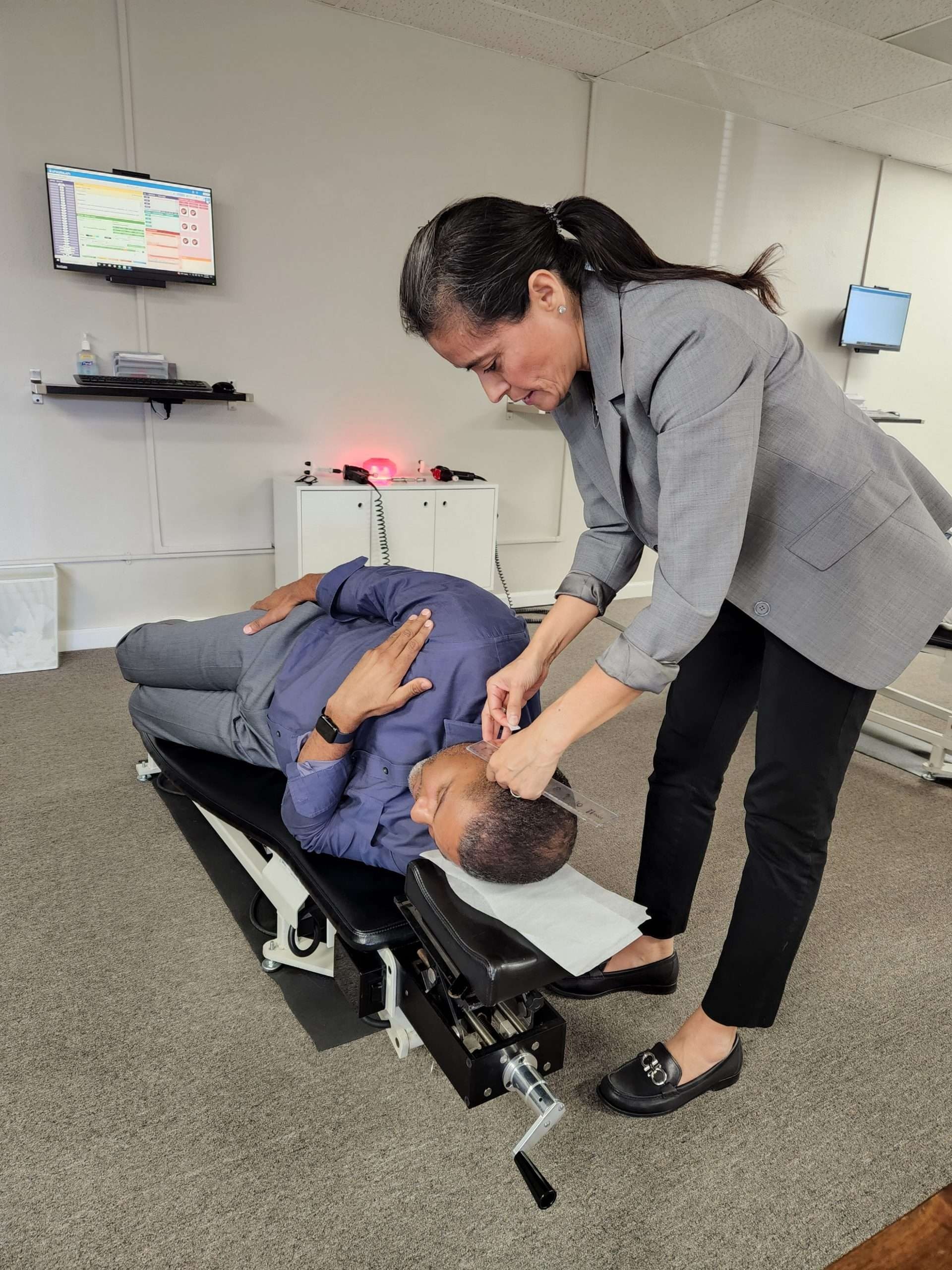
In fact, there are even highly specialized approaches, like NUCCA (National Upper Cervical Chiropractic Association), that involve zero popping, cracking, or twisting of the spine whatsoever. NUCCA chiropractic care focuses on a precise, gentle correction of the atlas vertebra (the top bone of the spine), using only a light, calculated touch near the base of the skull. Most patients are surprised by how mild the treatment feels.

For seniors, retirees, or anyone with concerns about bone density or joint sensitivity, this kind of approach can be a genuine game-changer. 

Misconception #2: “It’s too risky for older adults”

Many seniors assume chiropractic care is designed for younger, healthier bodies and that it carries real danger for those with osteoporosis, arthritis, or other age-related conditions. This concern is understandable, but largely unfounded when care is delivered by a qualified, experienced practitioner.

Trained chiropractors assess every patient individually, reviewing medical history, imaging, and physical condition before determining an approach. Techniques are adapted specifically for older adults, emphasizing comfort and safety at every step. Research consistently shows that when performed by a qualified professional, chiropractic care can improve mobility and decrease pain without serious risk, even in elderly patients.

Are there chiropractors that should be avoided? Absolutely. But that’s true with any profession or expertise. For seniors looking for things like treatment for chronic back pain, a good chiropractor can go a long way.

Misconception #3: “Chiropractors only treat back pain”

It’s true that most people walk into a chiropractor’s office with back pain. But limiting chiropractic care to a single symptom is like saying a cardiologist only treats chest pain.

Spinal misalignment, particularly at the top of the cervical spine, can affect far more than your back. Common conditions that respond well to chiropractic care, especially for older adults, include:

  • Chronic neck pain and stiffness
  • Headaches and migraines
  • Balance and coordination problems (a major fall-risk factor for seniors)
  • Joint pain and reduced range of motion
  • Sleep disturbances and fatigue
  • Brain fog and reduced mental clarity

For retirees trying to stay active, whether that means walking the golf course, playing with grandchildren, or simply navigating daily life with confidence, these benefits matter enormously.

Misconception #4: “You’ll need to go forever once you start”

This misconception often comes from a misunderstanding of how chiropractic care works. While some patients choose to make regular maintenance visits a part of their long-term wellness routine (similar to dental checkups), you are never “locked in.”

Many patients come in with a specific concern, receive a course of treatment, and achieve lasting relief, particularly with upper cervical approaches like NUCCA, which aim to deliver corrections that hold over time rather than requiring constant repeat adjustments. The goal is always to restore your body’s natural alignment so that it can maintain itself more effectively.

Your treatment plan is yours. A good chiropractor will communicate clearly, set realistic expectations, and respect your pace and goals.

Misconception #5: “It’s not real medicine, my doctor won’t approve”

Chiropractic care has long suffered from an image problem as being “fringe” or unscientific. That reputation is increasingly outdated. Numerous peer-reviewed studies demonstrate the efficacy of chiropractic adjustments for pain management, mobility improvement, and quality of life, and many primary care physicians now actively refer patients to chiropractors as part of a complementary care plan.

For seniors especially, the appeal of a drug-free, non-surgical approach to managing chronic pain and maintaining mobility is hard to overstate. 

It’s not about replacing your doctor, it’s about giving your body more tools to work with.

Why This Matters for Retirees and Seniors

Mobility is independence. The ability to move freely, stay balanced, and live without chronic pain directly shapes the quality of your retirement years. Chiropractic care, particularly the gentle, precision-based approaches now available, offers a compelling, low-risk option for seniors who want to stay active and avoid the side effects of long-term medication use.

If you’ve dismissed chiropractic care based on any of the myths above, it may be worth taking a second look, especially at upper cervical approaches designed with your comfort and safety in mind.

PKF

© 2026 Paul K. Fox and Eric White

.

Interview Clinic Revisited

A Quick Update from the MMEA Annual State Conference

Today (February 21, 2026) it was my pleasure to present at the Maryland Music Educators Association (MMEA) Annual State Conference in the Baltimore Convention Center.

The session was revised from past workshops at PMEA Annual and NAfME Eastern Division Conferences. Feel free to share these materials with fellow music education majors and NAfME college chapters… even hold meetings with them to sponsor group demonstrations of mock interviews to provide an audience and feedback for your practice sessions.

To-Do’s for Future Educators Seeking Employment

We have covered a lot of the concepts of “the art and science” of interviewing. As a review, here’s recap homework for anyone interested in developing better marketing, branding, and networking techniques, skills in storytelling at interviews, and improving their performance at employment screenings:

Standards: Define your personal mission, goals, and philosophy for teaching music, modeling the highest ideals of professionalism, ethics, and becoming the “total music educator.” Have you read the Model Code of Ethics for Educators brochure?

Marketing: Design and distribute a “state-of-the-art” résumé, e-portfolio, website, and business card.

Skills: Compile a list of anecdotes and true stories of you overcoming challenges, solving problems, and demonstrating  “best practices” of professionalism and self-improvement.

Assessment: Practice, record, and evaluate yourself answering behavioral & typical job interview questions

Review all the links here and this updated Ultimate Interview Primer handout and slide summary from the MMEA Annual State Conference.

Sample Slides

Click here for the entire slide summary.

Follow-up Reflections — The Top Ten!

Be ready to answer these in depth and with supportive evidence and sincerity at interviews:

  1. What is your philosophy for the study of music and the arts in the public schools?
  2. Why do you want to become a teacher? What motivates you to pursue this career path?
  3. What should be the most important emphasis in school curriculum — the mastery of content, outcome, or process?
  4. What is your personal mission, goals, and planned career trajectory?
  5. What are your most unique and essential personality characteristics and core values? (What matters to you most?)
  6. What are your most unique and essential professional habits that would equip you in becoming an effective educator?
  7. What is your proudest professional accomplishment? Why is this important to you? How would this relate to your teaching?
  8. What stories about your past positive interactions with children in education settings would demonstrate you modeled care, competence, compassion, and problem solving?
  9. How have you evolved in becoming a qualified educator during your pre-service field experiences?
  10. How and when have you “collected” and practiced responses to a large number of interview questions, including S.T.A.R. (Situation/Task/Action/Results) behavioral inquiries, and then recorded and assessed yourself doing these in a mock interviews or sessions of peer reviews?

One-Stop Help

In conclusion, about a year ago, I posted this Get-a-Job Toolbox blog. Please revisit the article, scroll down below the toolkit graphic, and follow in sequence as many of the published eighteen steps as possible.

High in the Himalayan mountains lived a wise old man. Periodically, he ventured down into the local village to entertain the villagers with his special knowledge and talents. One of his skills was to psychically tell the villagers the contents in their pockets, boxes, or minds. A few young boys from the village decided to play a joke on the wise old man and discredit his special abilities. One boy came up with the idea to capture a bird and hide it in his hands. He knew of course, the wise old man would know the object in his hands was a bird. The boy devised a plan. Knowing the wise old man would correctly state the object in his hands was a bird, the boy would ask the old man if the bird was dead or alive. If the wise man said the bird was alive, the boy would crush the bird in his hands, so that when he opened his hands the bird would be dead. But, if the wise man said the bird was dead, the boy would open his hands and let the bird fly free. So no matter what the old man said, the boy would prove the old man a fraud. The following week, the wise old man came down from the mountain into the village. The boy quickly caught a bird and cupping it out of sight in his hands, walked up to the wise old man and asked, “Old man, old man, what is it that I have in my hands?” The wise old man said, “You have a bird, my son.” And he was right. The boy then asked, “Old man, old man, tell me: Is the bird alive or is it dead?” The wise old man looked at the boy, thought for a moment and said, “The bird is as you choose it to be. It’s destiny is in your hands.”
Larry Broughton (also attributed to the Unitarian Universalist Association parable and Indian folk tale)

Indeed, regards to the preparation and practice of taking employment interviews and landing your “ideal job,” YOUR DESTINY IS IN YOUR HANDS.

A Plethora of Additional Resources

© 2026 Paul K. Fox